07 March 2025
P.R. Jenkins
Spotlight Ravel: Five orchestral works, Boléro and more
Five Orchestral Pieces
Karajan performed and recorded more pieces by Ravel than by Debussy, but it both cases he had his favourites while there were others that he conducted rarely or not at all. In concert he concentrated on the “Daphnis et Chloé” suite Nr. 2 (47 times) and the “Boléro” (28 times), the latter often as the culmination. He also interpreted “Rhapsodie Espagnole” (20 times) as second piece of his concerts. Karajan loved mixed programmes with a classical symphony by Haydn or Mozart at the beginning, a modern orchestral “showpiece” by Richard Strauss or Ravel before the interval and a great symphony from the 19th century repertoire (Beethoven, Brahms, Dvořák, Tchaikovsky) after it. In Karajan’s later years, when his concerts were shorter, he combined the “Pavane pour une infante défunte” with the “Boléro” in the second half, which thus lasted little more than 20 minutes. This was not because he was no longer up to it physically. He strongly believed that modern audiences could not take more than about an hour of music in a concert (opera was a different matter).
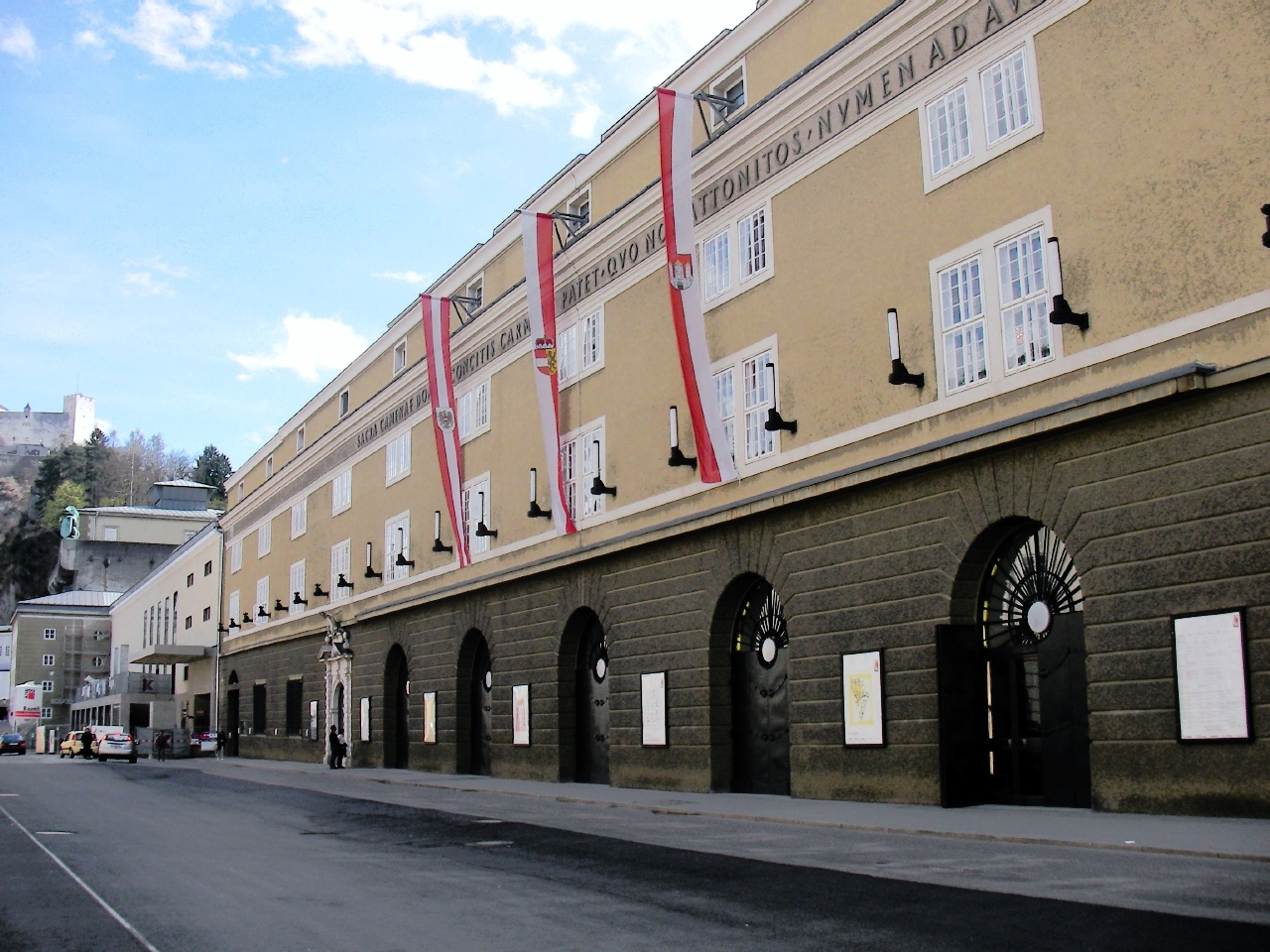
“La Valse” with its refined orchestration and its catastrophic final pages looked like an ideal piece to fill out Karajan’s repertoire of fateful music written around World War I (Berg op.6, “Elektra”, Mahler 6, Sibelius 4). But he only conducted it three times in concert at the beginning of his career (when Ravel was still alive!), one of them being his first encounter with the Vienna Philharmonic at a private concert in Salzburg’s “Mirabellgarten” in 1934. The only recording was a precious all-Ravel album in 1971, one of his rare studio sessions with the Orchestre de Paris “improvised out of thin air when a strike of technicians forced him to cancel film sessions in Paris (Richard Osborne)”. It also included two orchestrations of piano works – “Alborada del gracioso” and “Le tombeau de Couperin” – and the “Rhapsodie Espagnole” for the second time after his recording with the Philharmonia in 1953.
“No Karajan record surpasses this for sultry beauty.”
Richard Osborne
We’ve prepared playlists with Karajan conducting Ravel. Listen to Audio
Boléro
“I can walk in 120 and sing in 105; and if you ask me to sing in 105 now, I will manage it. If I get it wrong, I feel it with my whole body. And in the orchestra, if a solo comes in slower or faster, I sense it right away; it makes me feel uneasy.”
Karajan in 1989
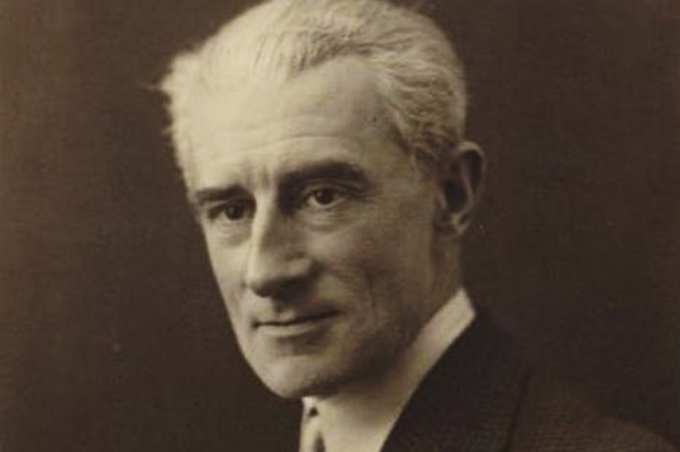
Many quotes by himself and many reports by his contemporaries and biographers suggest that Karajan was obsessed with rhythm. It is also well-known that he had a great passion for engineering and for cars and other vehicles, for any machine that worked with the highest possible precision. It is therefore no wonder that he had a great fable for the work of a composer, who Igor Stravinsky named “l’horloger suisse (the Swiss watchmaker)”. Maurice Ravel’s “Boléro” is one of the most popular pieces in classical music and it concerns rhythm to a great extent whereas its only two melodies are repeated 9 times in different instrumentations. Maybe that’s why Ravel said to Arthur Honegger: “I’ve only composed a single masterpiece, the ‘Boléro’. Unfortunately, it doesn’t contain any music.” Originally written as a ballet and first performed in 1928, it soon found its way to the concert halls and is still one of the fascinating show-pieces for orchestra. The difficult challenge for a conductor of the “Boléro” is to choose the right tempo and stick to it precisely throughout the complete piece, which lasts about 15 minutes and is structured by only one rhythmical figure repeated by the snare drum 169 times in exactly the same way. Ravel wasn’t at all content with the tempo that Karajan’s great idol Arturo Toscanini chose in 1930. Assumably, very few people dared to yell at Toscanini, who was already over 60 years old. Ravel, who was eight years younger, did so after a concert in Paris.
Keeping an exact tempo was an ability Karajan had like few other conductors (if any) and he was proud of it. As he mentioned to Richard Osborne, it wasn’t a natural gift but the result of rigorous training. There are two other elements that are often associated with the “Boléro” – meditation and hypnosis. Both had a constant fascination for Karajan throughout his lifetime. Richard Osborne quoted Gareth Morris, flute player of the Philharmonia Orchestra, about Karajan conducting the “Boléro”:
“He hardly moved. As you know, ‘Boléro’ works by a simple additive process. With the eyes closed and the hands barely chest high, Karajan gave us the beat with a single finger, and even that barely moved. With each new addition, the hands moved fractionally higher It was a form of hypnosis, I suppose. What we sensed was the power of the music within him, and that was bound to affect us. So with each slight lift of the hands the tension became even greater. By the end of the piece, the hands were above his head. And the power of that final climax was absolutely colossal.”
Karajan started conducting the “Boléro” on 4 December 1937 in Aachen when Ravel was still alive. He conducted it in the 1940s with the French Orchestre Radio-Symphonique, the Vienna Symphony and the Philharmonia Orchestra. Between 1966 and 1985, Karajan performed the “Boléro” 23 times and recorded it three times exclusively with the Berlin Philharmonic. The 1985 New Years Eve Concert was his last performance and was also filmed. Richard Osborne offers an interesting interpretation of Karajan’s approach to “Boléro”:
“In later years Karajan would frequently list those works which left him emotionally drained for days to come: ‘Elektra’, Sibelius’ Fourth Symphony, Mahler’s Sixth, the ‘Three Orchestral Pieces’ of Alban Berg, Honegger’s ‘Liturgique’. Much of this is war music, music that concerns itself with the gratuitous desecration and destruction of human life and values. ‘Boléro’ is too brief and too singular a piece to come into this category, but the frequency with which Karajan programmed it and the contexts in which he placed it suggests that it held a significance for him that went beyond that of a mere orchestral ‘étude’.”
Daphnis et Chloé
Maurice Ravel’s longest piece is “Daphnis et Chloé”. Lasting more or less an hour, it was written for Sergei Diaghilev’s “Ballets Russes” between 1909 and 1912.
“It is certainly not only one of Ravel’s most beautiful works but one of the most remarkable events in all French music.”
Igor Stravinski on „Daphnis and Chloé“
The entire ballet does not feature very often on concert programmes, as opposed to the two suites Ravel extracted from the ballet (partly even before the first performance) and especially the second of them. Ravel was one of the best orchestrators ever, and the beginning is a stunning impression of a summer sunrise complete with ravishing bird imitations and leading to the “Pantomime”, one of the great flute solos in the repertoire. The third part “Danse générale” is a wild bacchanal, akin to the relentless maelstrom of Ravel’s “La Valse” a few years later (like most conductors, Karajan performed the piece without Ravel’s choral part and its wordless keening).
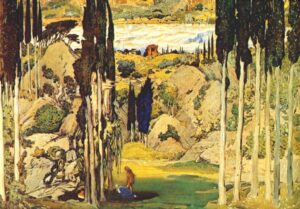
The second “Daphnis et Chloé” suite was the piece by Ravel, Karajan performed most often (47 times). It also was on the programme for a momentous concert in his life. The first concert with the Berlin Philharmonic on 8 April 1938 was the beginning of a relationship that lasted for over 50 years. Richard Osborne reports: “All the reviews agree that the suite from Ravel’s ‘Daphnis et Chloe’ was the highlight of the concert. Not even Heinrich Strobel, one of Berlin’s most experienced and exacting critics, whose knowledge of the score was second to none, could recall hearing a more atmospheric, a more brilliantly coloured or a more dazzlingly exact reading than this.”
Karajan produced two concert films of the suite in 1978 and in 1986.
We’ve prepared playlists for you with several recordings of „Daphnis and Chloé“ by Karajan including a life performance with James Galway playing the flute solo.
Listen here — P.R. Jenkins1 Richard Osborne, Herbert von Karajan: A Life in Music (1998).
2 Ibid.