15 May 2026
Pia Bernauer
Spotlight: Teatro alla Scala
First Encounters with La Scala
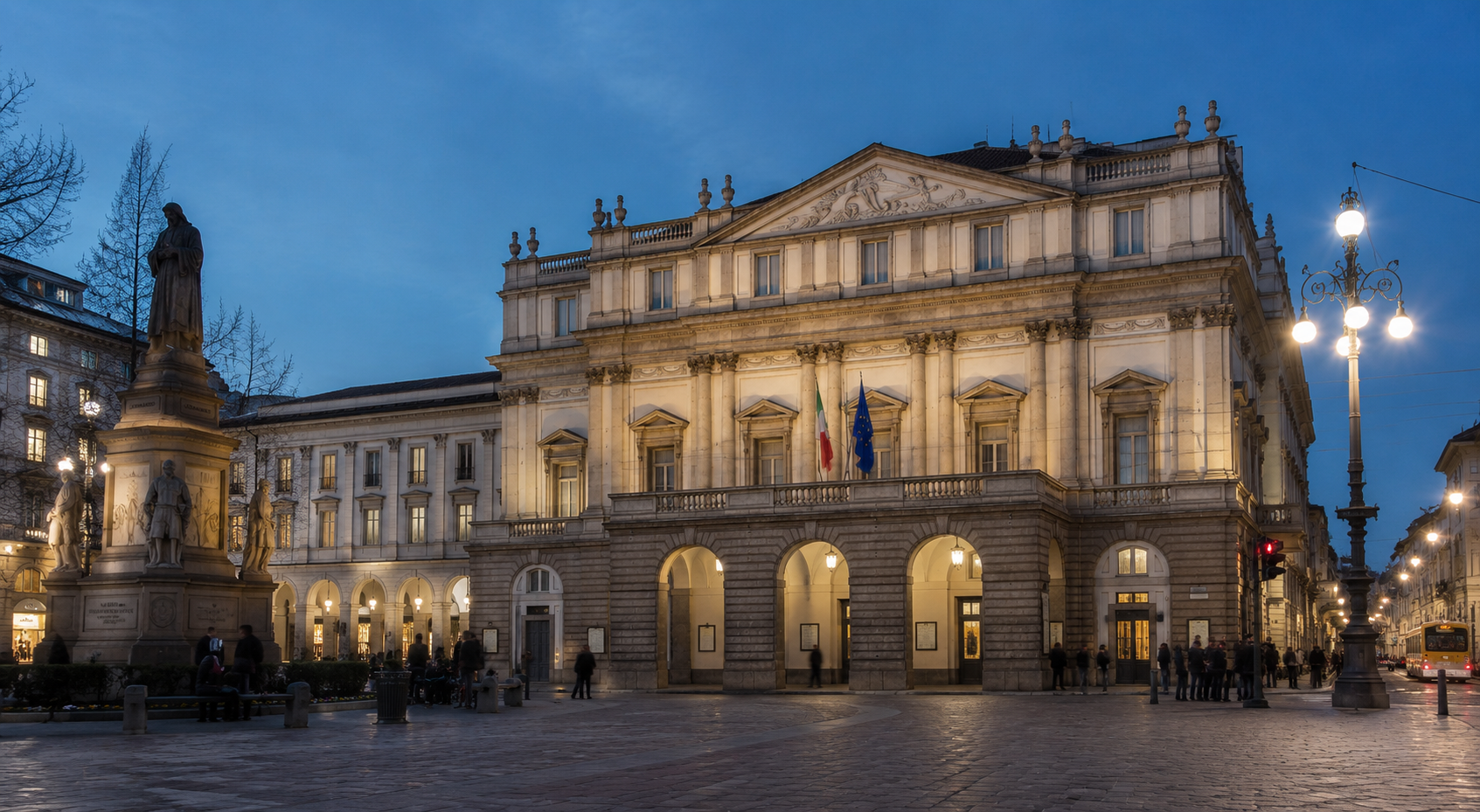
When La Scala reopened in May 1946 after the destruction of the Second World War, Arturo Toscanini conducted a concert that quickly became a symbol of cultural reconstruction in Europe. In the years that followed, the Milan opera house entered a new international phase — and Herbert von Karajan became one of the artists who shaped it most strongly.
Karajan had first appeared at La Scala already in 1940, conducting concerts with music by Richard Strauss, Brahms, Beethoven and Mozart. At the time, he was known in Italy mainly as a concert conductor. His later operatic work at La Scala had not yet begun.
After the war, however, Milan became one of the central stages of Karajan’s international career. Over nearly three decades, he returned to La Scala for productions with singers such as Maria Callas, Giuseppe di Stefano, Mirella Freni, Birgit Nilsson and Jon Vickers.
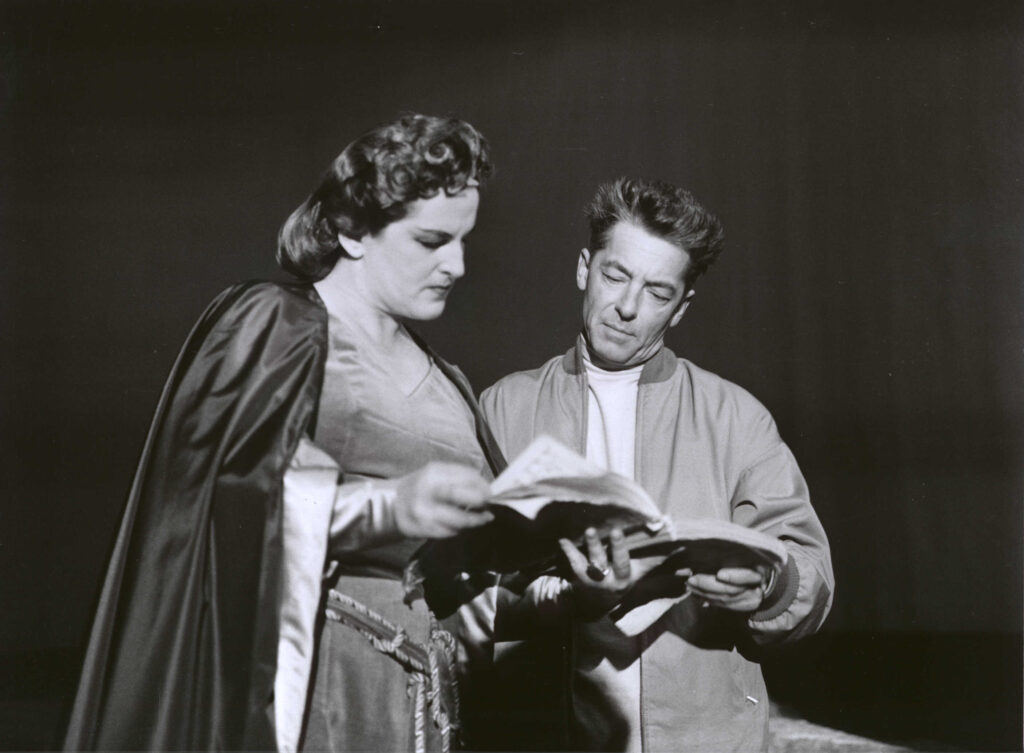
Birgit Nilsson as Isolde and Karajan glancing at the score, La Scala 1959 ©Erio Piccagliani; Karajan-Archive
La Scala and Karajan after 1945
After the Second World War, Milan became one of the most important places in the rebuilding of Karajan’s international career. While he remained isolated in parts of Europe in the immediate post-war years, Italy reopened artistic opportunities relatively quickly.
La Scala itself had also entered a new phase. After the destruction of the theatre in 1943, the house reopened in May 1946 with a concert conducted by Arturo Toscanini. Under the leadership of Antonio Ghiringhelli, the theatre increasingly expanded its international profile and opened itself more strongly to non-Italian repertoire.
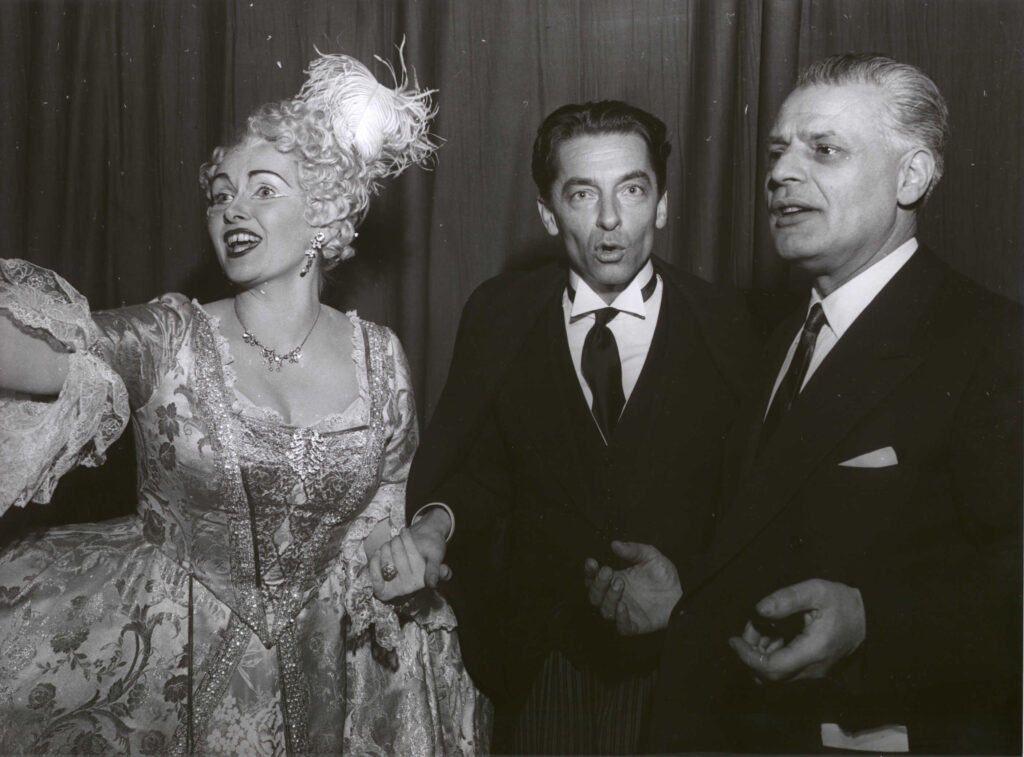
Elisabeth Schwarzkopf as the Marschallin, Karajan, and Antonio Ghiringhelli, 1952 ©Erio Piccagliani; Karajan-Archive
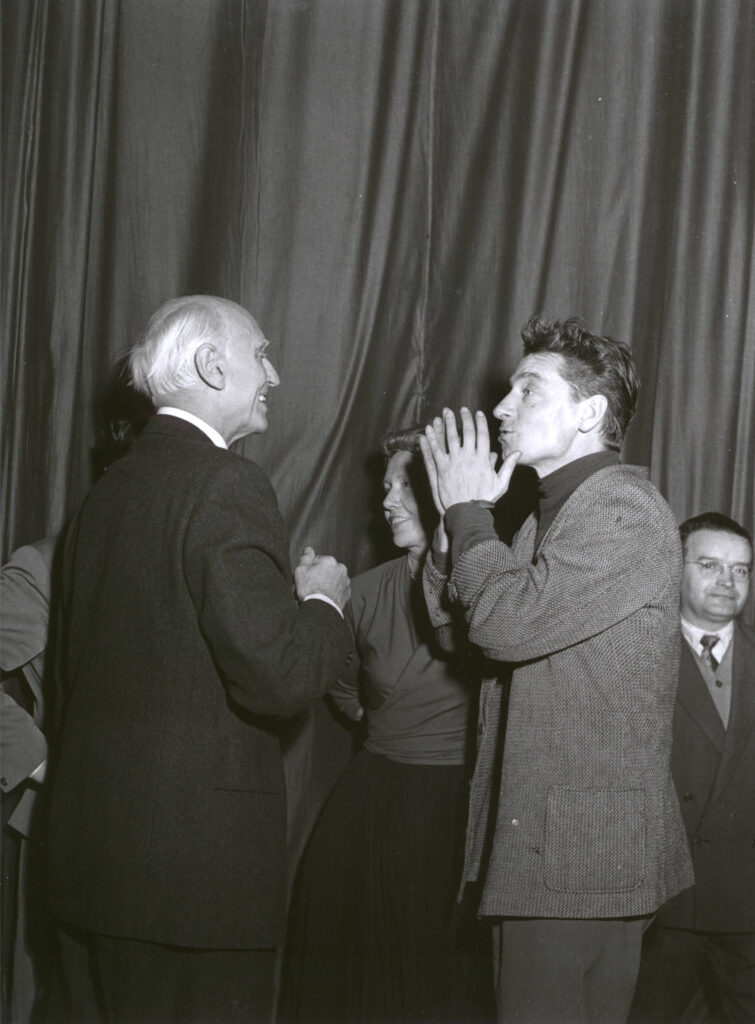
Victor de Sabata and Karajan, 1955 ©Erio Piccagliani; Karajan-Archive
Within this environment, Karajan soon returned to Milan. Victor de Sabata, one of Italy’s leading conductors at the time, played an important role in supporting Karajan’s early post-war work at La Scala. In 1948, Karajan appeared again at the theatre with concerts and guest performances by the Vienna State Opera, including Mozart’s Le nozze di Figaro with Elisabeth Schwarzkopf, Sena Jurinac and Giuseppe Taddei.
For Karajan, La Scala quickly became far more than a guest engagement. At a time when his international career was still rebuilding, Milan offered him access to an important artistic network, major singers and increasingly ambitious opera productions. During the following years, La Scala became one of the central stages of his post-war career.
Opera, Recordings and Film at La Scala
Karajan’s first major opera productions at La Scala remained closely connected to German and Austrian repertoire. In the early 1950s, he conducted productions of Wagner’s Tannhäuser and Lohengrin, Mozart’s Don Giovanni and Le nozze di Figaro, Beethoven’s Fidelio and Strauss’s Der Rosenkavalier. These productions brought singers such as Elisabeth Schwarzkopf, Sena Jurinac, Wolfgang Windgassen and Hans Hotter to Milan.
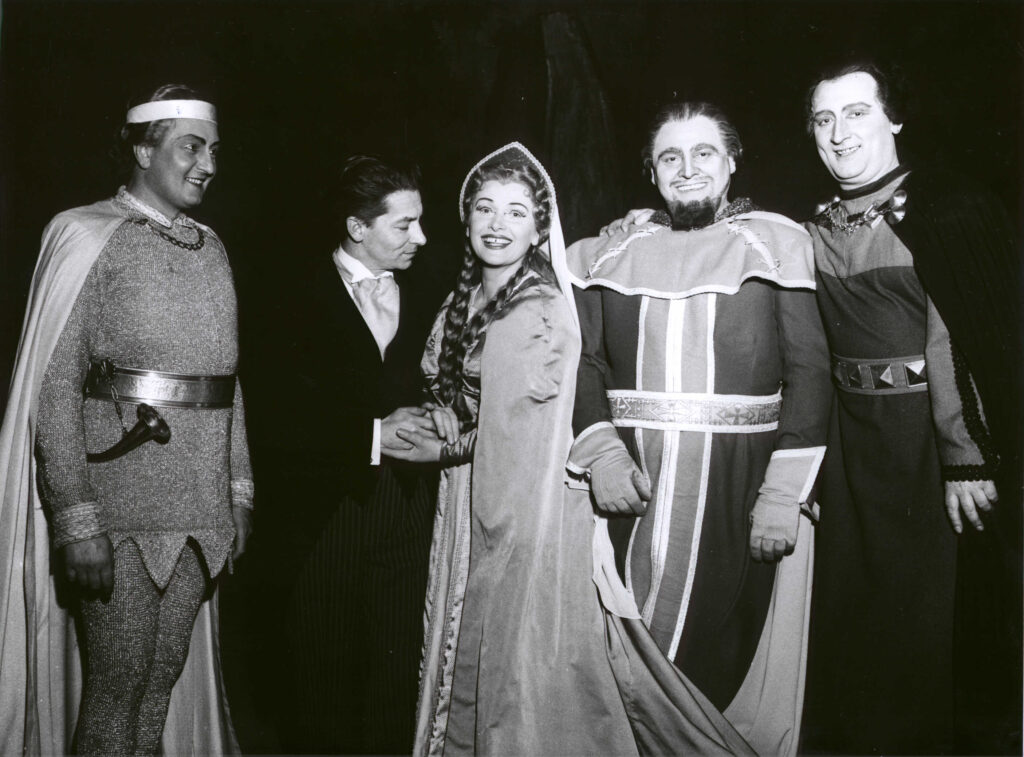
Wolfgang Windgassen as Lohengrin, HvK, Elisabeth Schwarzkopf as Elsa of Brabant, Otto Edelmann as King Henry, and Gustav Neidlinger as Friedrich von Telramund
In the early 1950s, Antonio Ghiringhelli increasingly encouraged Karajan to move beyond the German repertoire at La Scala. The decisive turning point came with Donizetti’s Lucia di Lammermoor in 1954 starring Maria Callas and Giuseppe di Stefano. Karajan had been deeply influenced by Arturo Toscanini’s approach to Italian opera and later recalled his own surprise at the dramatic power Toscanini revealed in the score:
“When we heard that Toscanini wanted to conduct this in Vienna, I honestly asked myself after playing through the vocal score, ‘What can there be in this?’”¹
The success of Lucia marked the beginning of Karajan’s deeper engagement with Italian opera. Over the following years, he conducted productions of Bizet’s Carmen, Verdi’s Falstaff and La Traviata, Puccini’s La Bohème, Wagner’s Die Walküre and Tristan und Isolde, as well as later productions of Mascagni’s Cavalleria rusticana and Leoncavallo’s Pagliacci. Many of these productions involved singers such as Maria Callas, Giuseppe di Stefano, Tito Gobbi, Mirella Freni, Birgit Nilsson, Jon Vickers, Leontyne Price and Nicolai Gedda.
Major Opera Productions at La Scala
| Year | Programme |
|---|---|
| 1948 | Wolfgang Amadeus Mozart: Le nozze di Figaro |
| Cast: Elisabeth Schwarzkopf · Irmgard Seefried · Sena Jurinac · Giuseppe Taddei · Ramon Vinay · Maria Cebotari | |
| 1950 | Richard Wagner: Tannhäuser und der Sängerkrieg auf Wartburg |
| Cast: Elisabeth Schwarzkopf · Elsa Cavelti · Hans Beirer · Hans Braun · Gottlob Frick | |
| 1951 | Wolfgang Amadeus Mozart: Don Giovanni |
| Cast: Victoria de los Angeles · Elisabeth Schwarzkopf · Giuseppe Taddei · Mario Petri · Sesto Bruscantini · Alda Noni | |
| 1952 | Ludwig van Beethoven: Fidelio |
| Cast: Martha Mödl · Lisa Della Casa · Wolfgang Windgassen · George London · Otto Edelmann · Hermann Uhde | |
| 1952 | Richard Strauss: Der Rosenkavalier |
| Cast: Elisabeth Schwarzkopf · Lisa Della Casa · Sena Jurinac · Otto Edelmann · Erich Kunz | |
| 1953 | Richard Wagner: Lohengrin |
| Cast: Elisabeth Schwarzkopf · Martha Mödl · Wolfgang Windgassen · Otto Edelmann · Josef Metternich | |
| 1953 | Wolfgang Amadeus Mozart: Don Giovanni |
| Cast: Elisabeth Schwarzkopf · Carla Martinis · Léopold Simoneau · Mario Petri · Sesto Bruscantini · Rolando Panerai · Alda Noni | |
| 1954 | Gaetano Donizetti: Lucia di Lammermoor |
| Cast: Maria Callas · Giuseppe di Stefano · Rolando Panerai · Giuseppe Modesti · Louisa Villa | |
| 1954 | Wolfgang Amadeus Mozart: Le nozze di Figaro |
| Cast: Elisabeth Schwarzkopf · Irmgard Seefried · Sena Jurinac · Rolando Panerai · Mario Petri | |
| 1955 | Georges Bizet: Carmen |
| Cast: Giulietta Simionato · Giuseppe di Stefano · Michel Roux · Rosanna Carteri · Graziella Sciutti | |
| 1955 | Wolfgang Amadeus Mozart: Die Zauberflöte |
| Cast: Elisabeth Schwarzkopf · Erika Köth · Nicolai Gedda · Giuseppe Taddei · Nicola Zaccaria | |
| 1956 | Richard Strauss: Salome |
| Cast: Christel Goltz · Max Lorenz · Hans Hotter | |
| 1957 | Giuseppe Verdi: Falstaff |
| Cast: Tito Gobbi · Rolando Panerai · Anna Moffo · Elisabeth Schwarzkopf · Luigi Alva | |
| 1958 | Richard Wagner: Die Walküre |
| Cast: Birgit Nilsson · Leonie Rysanek · Jean Madeira · Ludwig Suthaus · Hans Hotter · Gottlob Frick | |
| 1959 | Richard Wagner: Tristan und Isolde |
| Cast: Birgit Nilsson · Wolfgang Windgassen · Hans Hotter · Gustav Neidlinger · Hilde Rössel-Majdan | |
| 1960 | Wolfgang Amadeus Mozart: Le nozze di Figaro |
| Cast: Sena Jurinac · Graziella Sciutti · Geraint Evans · Eberhard Wächter | |
| 1960 | Ludwig van Beethoven: Fidelio |
| Cast: Birgit Nilsson · Jon Vickers · Hans Hotter · Gottlob Frick · Wilma Lipp · Gerhard Unger | |
| 1963 | Giacomo Puccini: La Bohème |
| Cast: Mirella Freni · Gianni Raimondi · Ivo Vinco · Gianni Maffeo · Eugenia Ratti | |
| 1964 | Giuseppe Verdi: La Traviata |
| Cast: Anna Moffo · Mirella Freni · Renato Cioni · Mario Sereni · Nicola Zaccaria | |
| 1966–1968 | Pietro Mascagni: Cavalleria rusticana |
| Cast: Fiorenza Cossotto · Gianfranco Cecchele · Gian Giacomo Guelfi · Adriana Martino · Anna di Stasio | |
| 1968 | Ruggero Leoncavallo: Pagliacci |
| Cast: Jon Vickers · Raina Kabaivanska · Peter Glossop · Rolando Panerai · Sergio Lorenzi |
La Scala also became an important recording and film location within Karajan’s career. Productions and concerts were documented through EMI and Deutsche Grammophon studio recordings, radio broadcasts and later film productions. Among the most important recordings connected to La Scala were Madama Butterfly with Maria Callas and Nicolai Gedda, Verdi’s Il trovatore with Callas and Giuseppe di Stefano, La Bohème with Mirella Freni, as well as the filmed productions of Cavalleria rusticana, Pagliacci and Verdi’s Messa da Requiem from the late 1960s.
Several of these recordings and productions can still be heard today and form part of the playlist accompanying this article.
How La Scala Shaped Karajan’s Artistic World
Karajan’s years at La Scala shaped much of his later work. In Milan, he encountered the Italian stagione system at its highest level. Unlike the repertory system common in many German-speaking opera houses, productions at La Scala were prepared intensively for a limited series of performances. This allowed longer rehearsal periods, carefully assembled casts and much greater musical and visual concentration.
These working conditions suited Karajan especially well. Productions were prepared in detail, often with international singers performing in their original languages. During the 1950s and 1960s, La Scala became a place where Karajan refined many of the ideas that later defined his own productions.
Directors such as Franco Zeffirelli and Giorgio Strehler became important collaborators, especially in the later Italian productions. At the same time, recording projects increasingly accompanied stage performances, creating a close connection between live performance, studio work and visual presentation.

HvK and Giorgio Strehler, 1966, ©Erio Piccagliani; Karajan-Archive
Many of these elements later reappeared in Vienna and Salzburg. At the Vienna State Opera, Karajan pushed for longer rehearsal periods and more unified productions. When he founded the Salzburg Easter Festival in 1967, he created conditions that strongly resembled the concentrated stagione model he had experienced in Milan: limited performances, extensive rehearsals and casts assembled specifically for each production.
La Scala therefore became far more than a guest venue in Karajan’s career. It was one of the places where his later artistic method fully developed — combining music, theatre, rehearsal discipline and recording into a single artistic concept.
¹ Richard Osborne, Herbert von Karajan: A Life in Music, p. 72