24 April 2026
Pia Bernauer
Weekly SpinOn: Home

What does “home” mean?
In English, the word usually refers to a private space—the place where someone lives. The German word Heimat works differently. It can describe a region, a country, or a shared cultural environment.
This difference is not accidental. Linguists often point out that languages develop words for what is socially relevant. In German-speaking regions, Heimat emerged in the 19th century as a term shaped by regional identity, political change, and later by migration and displacement. It refers not only to where someone lives, but to a broader sense of belonging tied to place, language, and history.
English developed along a different path. Words like home, homeland, or native place exist, but none of them combine all these aspects into a single term. Instead, the concept is expressed through context rather than one specific word.
This week’s playlist follows that broader idea of Heimat. The works approach belonging from different angles—through landscape, memory, distance, and return.
Track 1: Aida: “O patria mia” – Verdi
Mirella Freni · Wiener Philharmoniker · Herbert von Karajan
Opera in the 19th century often reflects broader political and social developments. As national identities became more clearly defined, questions of origin and belonging gained new importance. These themes appear not only in explicitly national subjects, but also in works set in distant or historical contexts.
In Verdi’s Aida, this development is evident in the central conflict of the opera. Although the setting is ancient Egypt, the dramatic situation is shaped by the tension between personal relationships and attachment to one’s homeland. The aria “O patria mia” presents this aspect in a particularly concentrated form.
Within the structure of the opera, the aria marks a point of consolidation rather than development. The central conflict—Aida’s position between her life in Egypt and her origin as an Ethiopian princess—is already established. In the aria, Aida sings of her homeland, which appears only as a distant and inaccessible memory. The dramatic action is suspended, and the focus shifts entirely to her perspective. In this sense, the aria clarifies rather than advances the situation.
The term patria is central in this context. It refers not to a private home, but to a country understood as a geographical and cultural entity. This places it closer to the concept of Heimat introduced above, which likewise extends beyond the idea of a domestic space and describes belonging on a broader, collective level.
Verdi’s musical setting corresponds to this perspective. The vocal line unfolds in long, sustained phrases, while the orchestral texture remains transparent and restrained. The emphasis lies on continuity and control rather than contrast or display, reinforcing the sense of distance that defines the aria.
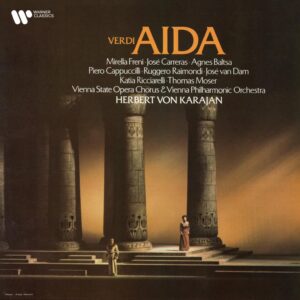
The recording was made in Vienna in May 1979 with Mirella Freni in the title role, the Wiener Philharmoniker and Herbert von Karajan, and released by EMI in 1980 as part of a complete studio recording of the opera. Freni’s interpretation differs from the more dramatic tradition often associated with the role. As a lyric soprano, she emphasizes clarity of line and control rather than vocal weight, which aligns closely with the restrained character of the aria. The album was recently rereleased by Warner Classics on all major streaming services.
Track 2: Má vlast: “Vltava (The Moldau)” – Smetana
Wiener Philharmoniker · Herbert von Karajan
In the context of 19th-century national movements, particularly in regions without their own statehood, such as Bohemia within the Habsburg Empire, landscape becomes a central marker of collective identity.
Bedřich Smetana composed Má vlast (“My homeland”) between 1874 and 1879 as a cycle of six symphonic poems, each dedicated to a different aspect of Bohemia. The works combine references to history, legend and geography, forming a musical representation of a shared cultural space.
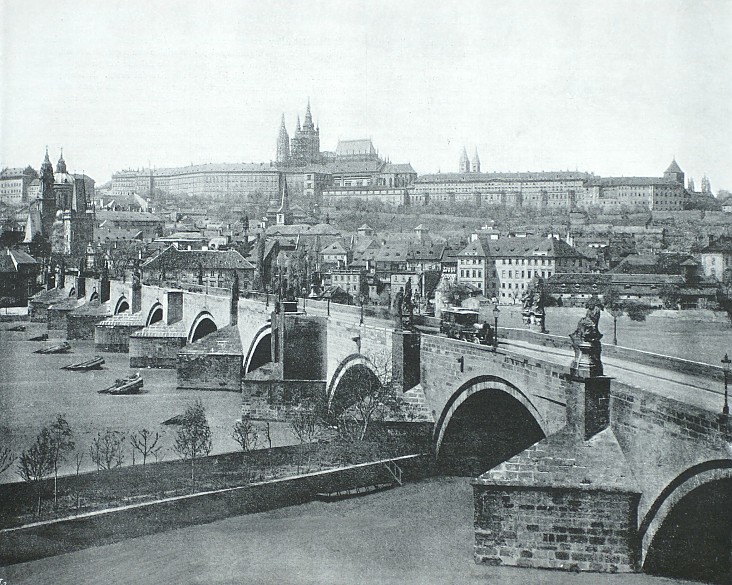
Hradčany (castle of Prague) as seen from the Vltava River, photograph, 19th century
The second movement, “Vltava”, is the most widely known. It traces the course of the river Moldau from its two sources through forests and countryside to the city of Prague. This progression provides the structural basis of the piece: a continuous flow, shaped by changing orchestration and recurring transformations of the main theme.
Smetana’s intention is not purely descriptive. The river functions as a unifying element, connecting different regions and experiences into a single trajectory. Landscape is not presented as static, but as something that unfolds over time.
In this context, Heimat is defined through shared geographical space. It is not tied to political borders, but to a landscape that can be experienced collectively and represented through music.
Track 3: Die Zauberflöte: “Ach, ich fühl’s” – Mozart
Edith Mathis · Berliner Philharmoniker · Herbert von Karajan
We remain within the Habsburg Empire, but move to an earlier period.
In the late 18th century, before the emergence of modern national identity, belonging is less often defined through territory or landscape. Instead, it is shaped through language, social structures and cultural practice.
Under Emperor Joseph II, efforts were made to promote German in administration and theatre in order to create a more unified and accessible public sphere within the multi-ethnic empire. The German-language Singspiel emerges in this context as an alternative to the Italian opera that had long dominated court culture.
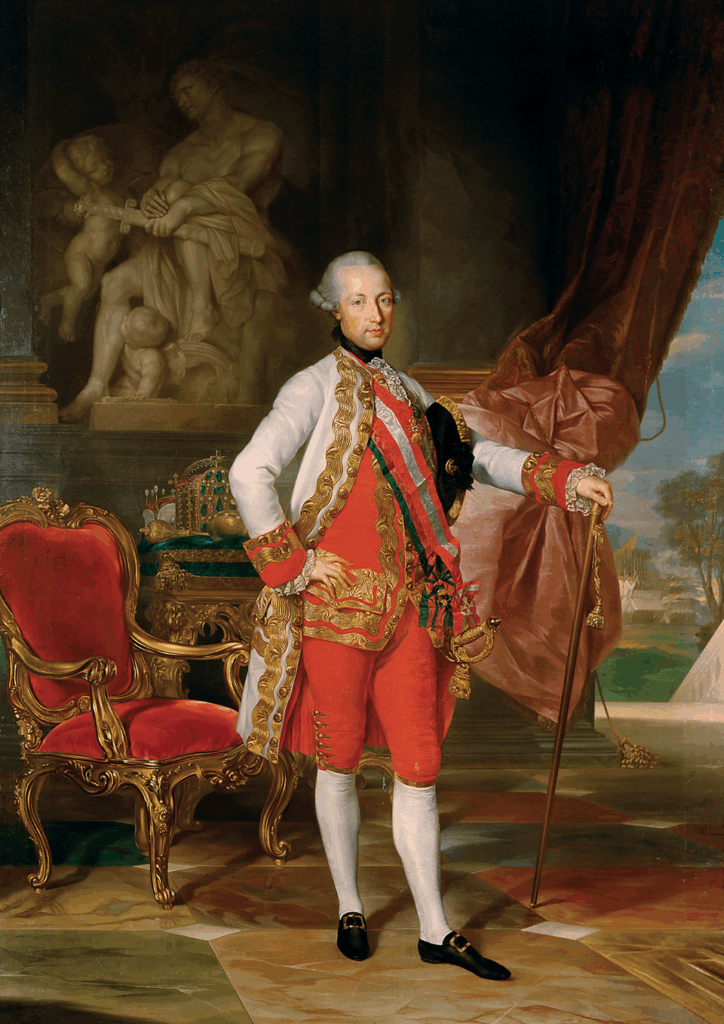
Joseph II, circa 1775 (painting by Anton von Maron)
Mozart’s Die Zauberflöte, premiered in 1791, forms part of this development. As a Singspiel in German, it addresses a broader audience and contributes to the formation of a shared cultural space defined by language rather than geography.
The aria “Ach, ich fühl’s”, sung by Pamina, reflects this setting on an individual level. The musical structure remains clear and continuous, with a sustained vocal line supported by a reduced orchestral texture. The emphasis lies on legato phrasing and formal balance rather than contrast.
The recording was made between January and April 1980 in the Philharmonie in Berlin with the Berliner Philharmoniker under Herbert von Karajan and released by Deutsche Grammophon in the same year as part of a complete studio recording of the opera. Edith Mathis sings Pamina. The interpretation reflects Karajan’s late Mozart style, characterized by sustained tempi, a homogeneous orchestral sound and an emphasis on continuity. Mathis’s singing is marked by a clear, focused tone and precise diction, with the vocal line closely integrated into the orchestral texture.
Track 4: Symphony No. 9 “From the New World”: II. Largo – Dvořák
Berliner Philharmoniker · Herbert von Karajan
The Symphony No. 9, “From the New World” (1893), was composed during Antonín Dvořák’s stay in the United States. The work is linked to a broader idea: the attempt to define a shared musical identity for a society shaped by immigration, while simultaneously reflecting Dvořák’s own cultural nostalgia.
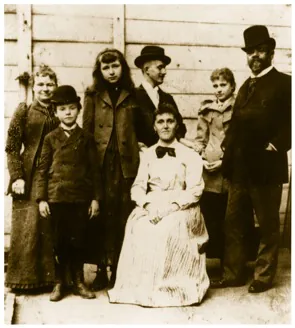
The Dvořáks in the United States. On the right is Antonín Dvořák; to his left is his daughter Otilie. In the center, wearing a hat, is Dvořák’s assistant Kovarik.
The second movement (Largo) begins with a solemn brass chorale. It features a curious orchestral detail: the tuba is required for only seven bars in the entire symphony, yet its presence here is crucial to establish a dark, stable harmonic foundation. This opening sets the stage for the famous main theme, introduced by the cor anglais. The instrument’s timbre, strikingly similar to both a harmonica and the human voice, carries a sense of quiet longing. This theme is often mistaken for a traditional spiritual, but it was actually an original melody by Dvořák. The association with folk tradition only grew later, when his student William Arms Fisher turned it into the song “Goin’ Home.” Dvořák’s use of muted strings (con sordino) to accompany the melody further enhances this intimate, restrained atmosphere, making the music feel like a private memory.
While often described as a product of intense homesickness, Dvořák’s reality was more nuanced. He was fascinated by the American landscape and the success he found in New York. However, his time in the Czech-immigrant community of Spillville, Iowa, suggests he sought out the familiar to balance the pressures of the metropolis. The Largo reflects this duality—not as a cry of despair, but as a moment of calm introspection.
In this context, “home” is not a single location. It exists between two worlds—the vastness of America and the traditions of Bohemia. In this recording, Herbert von Karajan and the Berliner Philharmoniker emphasize the movement’s atmospheric depth, allowing the unique colors of the cor anglais and the subtle textures of the muted strings to capture Dvořák’s quiet contemplation of belonging.
— Pia Bernauer (Karajan Institut, Salzburg)