19 March 2026
Pia Bernauer
Karajan artists: Orchestre de Paris – a sound in the making
“An orchestra does not produce sound by itself — it must be shaped.”
When Herbert von Karajan began working with the newly founded Orchestre de Paris, he encountered an ensemble still at the beginning of its story — and still discovering its own musical identity.
The Orchestre de Paris gave its inaugural concert on 14 November 1967 under the direction of Charles Munch. Conceived as the successor to the Société des Concerts du Conservatoire, it was meant to embody the ideals of a modern French symphonic tradition on an international stage. But Munch’s sudden death in 1968 left the young orchestra without clear artistic direction.
At this transitional moment Karajan entered the picture. He was not appointed chief conductor but musical advisor — a role that reflected both the orchestra’s ambitions and the limits of Karajan’s time. As Richard Osborne later observed, Karajan was willing to shape and guide the orchestra without accepting formal institutional responsibility.
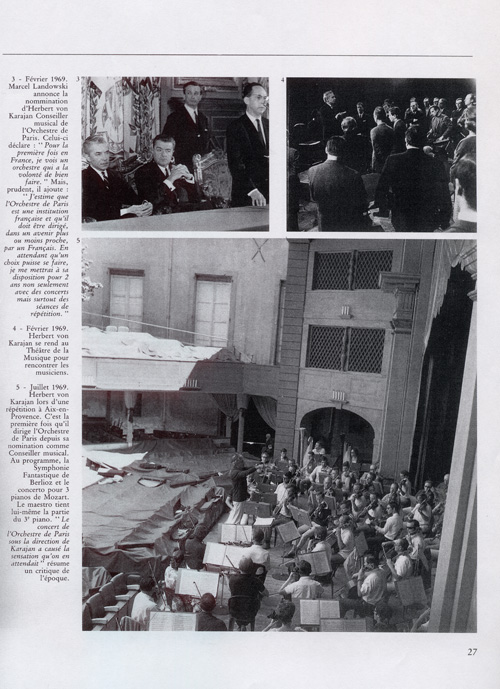
The collaboration was therefore never intended as a long‑term partnership. Instead, it consisted of a series of tightly focused encounters — in concerts, recording sessions and filmed productions — between 1969 and 1971.
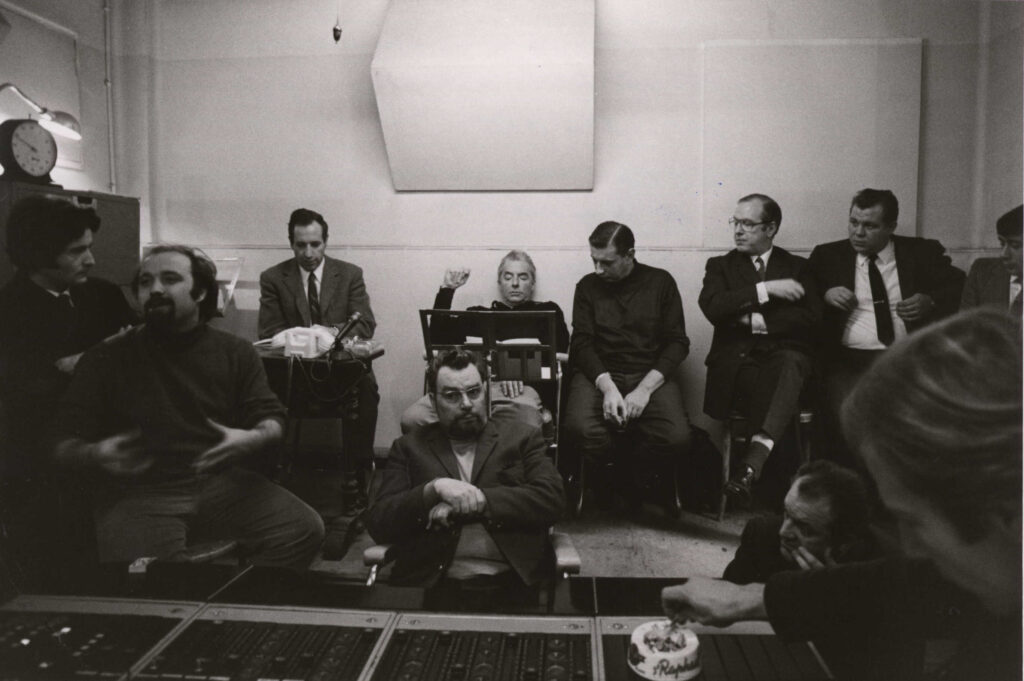
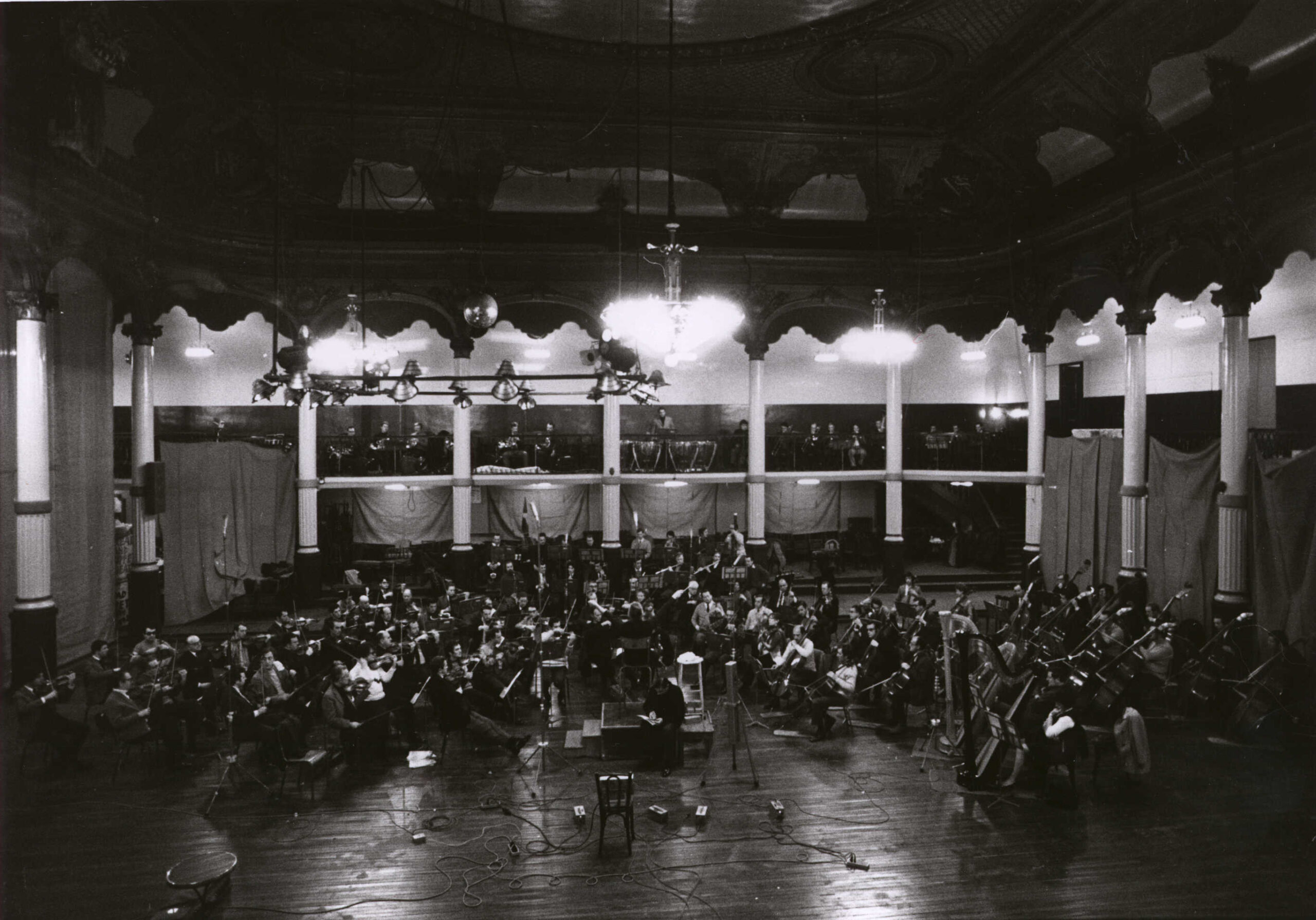
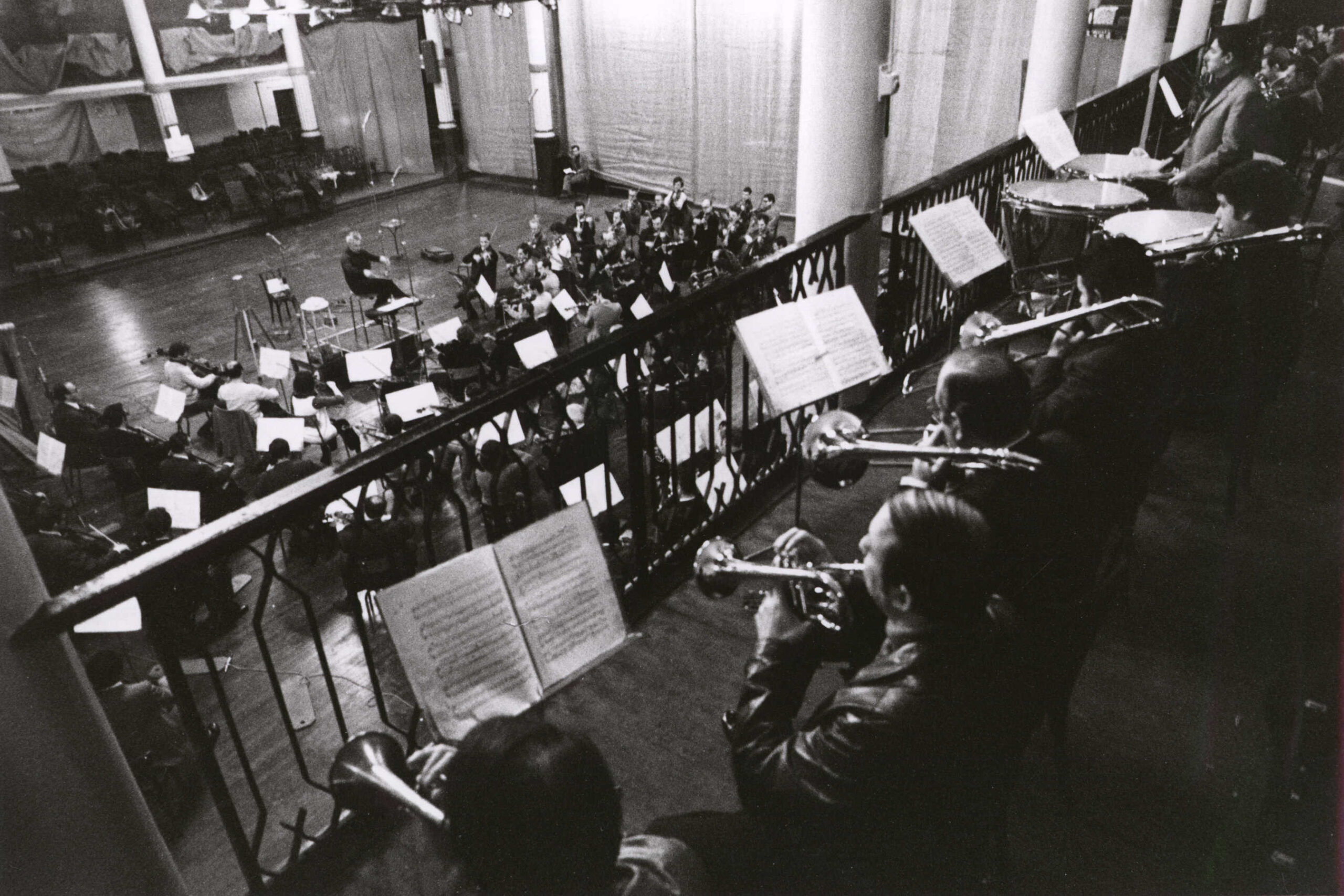
Karajan and members of the Orchestre de Paris in the recording studio during the recording of César Franck’s “Symphony in D minor”, 1969 ©Siegfried Lauterwasser; Karajan-Archive
The first sessions took place in November 1969 in Paris, featuring César Franck’s Symphony in D minor. A few months later, in February 1970, came Tchaikovsky’s First Piano Concerto. At the same time, work began on a filmed production of Berlioz’s Symphonie fantastique, realised between June 1970 and October 1971.
These projects already sketched the profile of the collaboration: French music stood at its centre, yet it was framed by key works of the broader European repertoire. Karajan brought to this partnership his unmistakable structural clarity, while the orchestra was still in the process of shaping its characteristic sound.
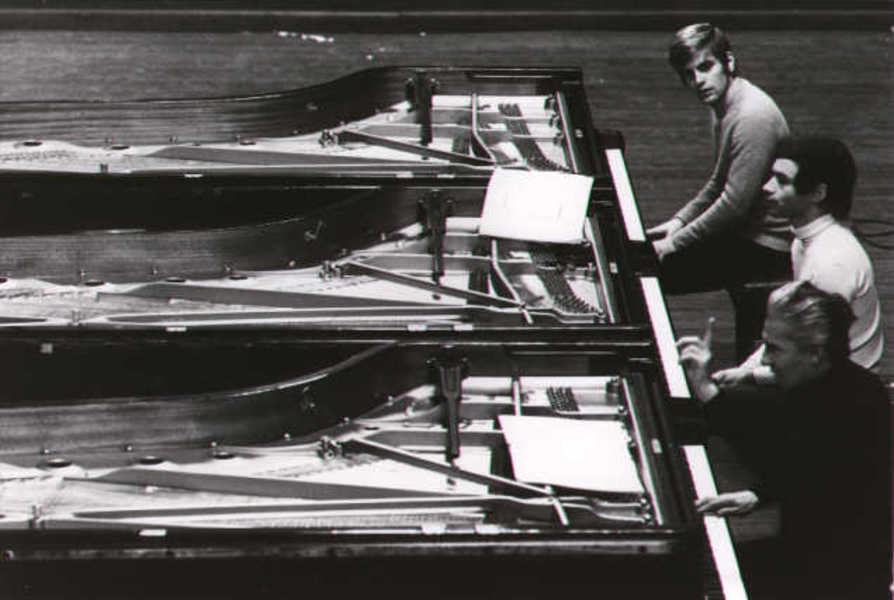
Karajan at the piano with Christoph Eschenbach and Justus Frantz during a rehearsal of W. A. Mozart’s “Concerto for Three Pianos and Orchestra in F Major”, 1971©Siegfried Lauterwasser; Karajan-Archive
In October 1971 Karajan conducted — and also played one of the solo parts in — Mozart’s Concerto for Three Pianos in F major in a televised production from Paris. Joined by Christoph Eschenbach and Justus Frantz, he formed a trio that united different generations of pianists. The work itself, more a conversation among three keyboards than a vehicle for solitary virtuosity, becomes through Karajan’s dual role a rare document of his artistry beyond the podium.
The most concentrated recording period came in June 1971, when, over just two days in Paris, Karajan recorded four works by Maurice Ravel: La Valse, Alborada del gracioso, Le tombeau de Couperin and Rapsodie espagnole. These sessions were not initially planned; according to Osborne, they were “improvised out of thin air” after a technicians’ strike forced the cancellation of scheduled film recordings.
The result was a compact yet remarkably cohesive project — not a single monumental work but a group of pieces capturing the orchestra at a defining moment in its early musical evolution.
Alongside these studio projects, Karajan appeared with the orchestra in Paris concerts, combining French repertoire with works by Brahms and Franck. These performances, selective and project‑based, remained consistent with his advisory position.
A final filmed production reunited Karajan and the Orchestre de Paris in September 1980, when he conducted Berlioz’s Symphonie fantastique in Berlin. By then, however, the main phase of their collaboration was long past.
Karajan’s work with the Orchestre de Paris did not result in large cycles or long-term projects. There was no permanent position, no continuous presence over many seasons — but a clearly defined moment in the orchestra’s early history.
Years later, Karajan would reflect on this period:
— Pia Bernauer (Karajan Institute)“I might have died trying to be in Berlin, Salzburg and Paris at the same time. Since I love Paris more than any other city, I would never have left it again.”
1 Richard Osborne, Herbert von Karajan: A Life in Music (London: Chatto & Windus, 1998).
2 Ibid.