11 June 2026
Pia Bernauer
Spotlight: Günther Schneider-Siemssen – Painting with Light

On June 7, 2026, Günther Schneider-Siemssen would have celebrated his 100th birthday. Although he spent most of his career behind the scenes, few stage designers were as closely associated with the visual world of Herbert von Karajan as he was.
Over nearly three decades, conductor and designer developed a distinctive theatrical language based on light, projection and atmosphere. As we mark Schneider-Siemssen’s centenary, we look back at a creative partnership that helped shape some of the most memorable opera productions of the post-war era.
The Breakthrough in Bremen
The collaboration began unexpectedly in Bremen. While touring with the Berliner Philharmoniker, Herbert von Karajan paid a courtesy visit to the local theatre. To the surprise of the staff, he specifically asked to see the set designs for a production of Fidelio created by the young Günther Schneider-Siemssen.
Colleagues quickly sensed the potential of the encounter, remarking that Schneider-Siemssen was “exactly the right man for Karajan.”¹ About a year and a half later, the designer arrived in Vienna carrying a large portfolio of sketches. It marked the beginning of one of the longest and most productive artistic collaborations of Karajan’s career.
A Triumphant Debut in Vienna
The defining idea of their partnership was surprisingly simple: reducing physical scenery in favour of light. This approach emerged fully in 1962, when Karajan entrusted Schneider-Siemssen with Claude Debussy’s Pelléas et Mélisande at the Vienna State Opera, alongside new productions of Mozart’s Die Zauberflöte and Beethoven’s Fidelio.
At the time, opera productions were often dominated by elaborate and costly stage constructions. When some voices in Vienna proposed engaging Salvador Dalí, Karajan dismissed the idea. He encouraged his new designer to forget both Dalí and the traditional “Materialschlachten” of operatic stagecraft.
Schneider-Siemssen responded with a bold proposal:
We replace everything, absolutely everything, with light and projections.²
For audiences in Vienna, the result was unlike anything they had seen before. Instead of massive physical structures, atmosphere, colour and projected imagery became the principal elements of the stage picture.
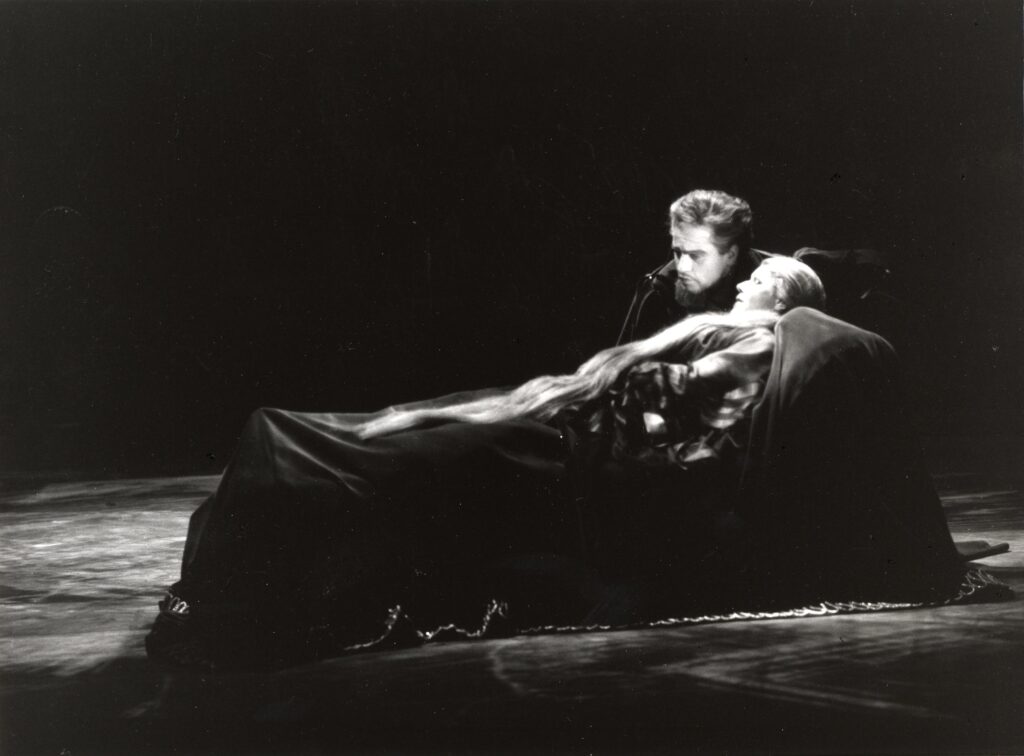
Nicola Zaccaria as King Arkel and Hilde Güden as Mélisande, Vienna State Opera, 1962, ©Photo Fayer;Karajan-Archive
The “Licht-Partitur” and Hands-On Collaboration
This philosophy became the hallmark of their work. Rather than treating the stage as a fixed architectural space, Karajan and Schneider-Siemssen approached it as something fluid and psychological, shaped by music and light.
Schneider-Siemssen often spoke about Karajan’s extraordinary attention to visual detail. The conductor’s lighting instructions were so extensive and precisely timed that he described them as a “Licht-Partitur” — a “light score” every bit as complex as the musical score itself.
Yet their collaboration was not only meticulous; it could also be remarkably informal. During preparations for new productions, the two men frequently worked on miniature stage models in hotel rooms.
Schneider-Siemssen later recalled:
We knelt on the floor, pushed the tables aside, and Karajan experimented.³
Behind the prestige of the productions stood countless hours of practical experimentation, curiosity and shared enthusiasm.
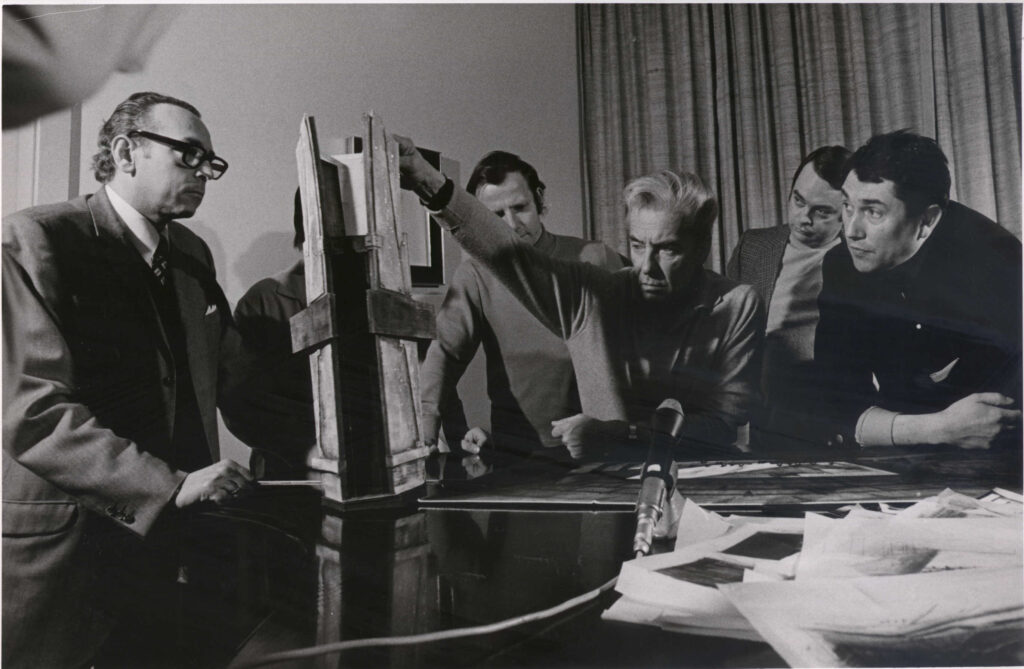
At a production meeting for Fidelio with Peter Busse, Wolfgang Weber, Günther Schneider-Siemssen, Salzburg 1971 ©Siegfried Lauterwasser; Karajan Archive
Cosmic Scales at the Salzburg Easter Festival
Their ideas reached a new scale with the founding of the Salzburg Easter Festival. Here Schneider-Siemssen found the ideal platform for the visual concepts he had begun developing in Vienna.
For Wagner’s Der Ring des Nibelungen, he created an aesthetic world that relied less on realistic scenery than on symbols, projections and light. In Das Rheingold, he introduced the famous “Ring Ellipse”, a visual motif that became associated with the entire cycle.
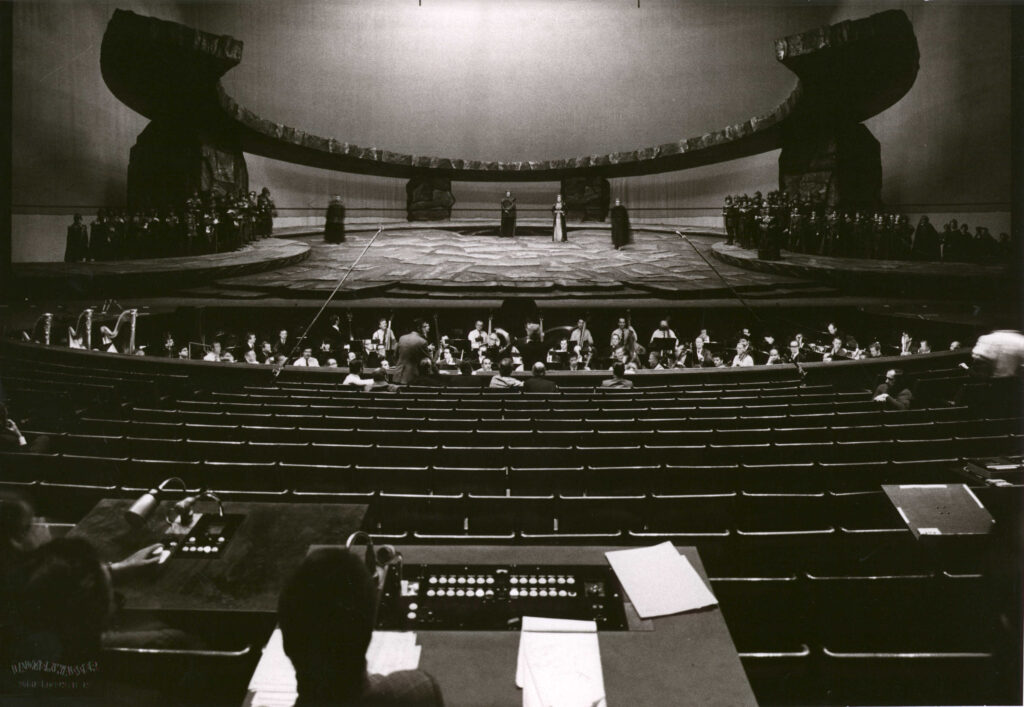
Twilight of the Gods: Photo from rehearsals, 1970, the famous Ring ellipse ©Siegfried Lauterwasser; Karajan-Archive
Particularly striking was Die Walküre. Through large-scale projections and carefully controlled lighting, Schneider-Siemssen created a sense of weightlessness that placed the drama in an almost cosmic environment of clouds, movement and colour.
The production later formed the basis of performances at the Metropolitan Opera in New York, bringing the visual language developed in Salzburg to an international audience.
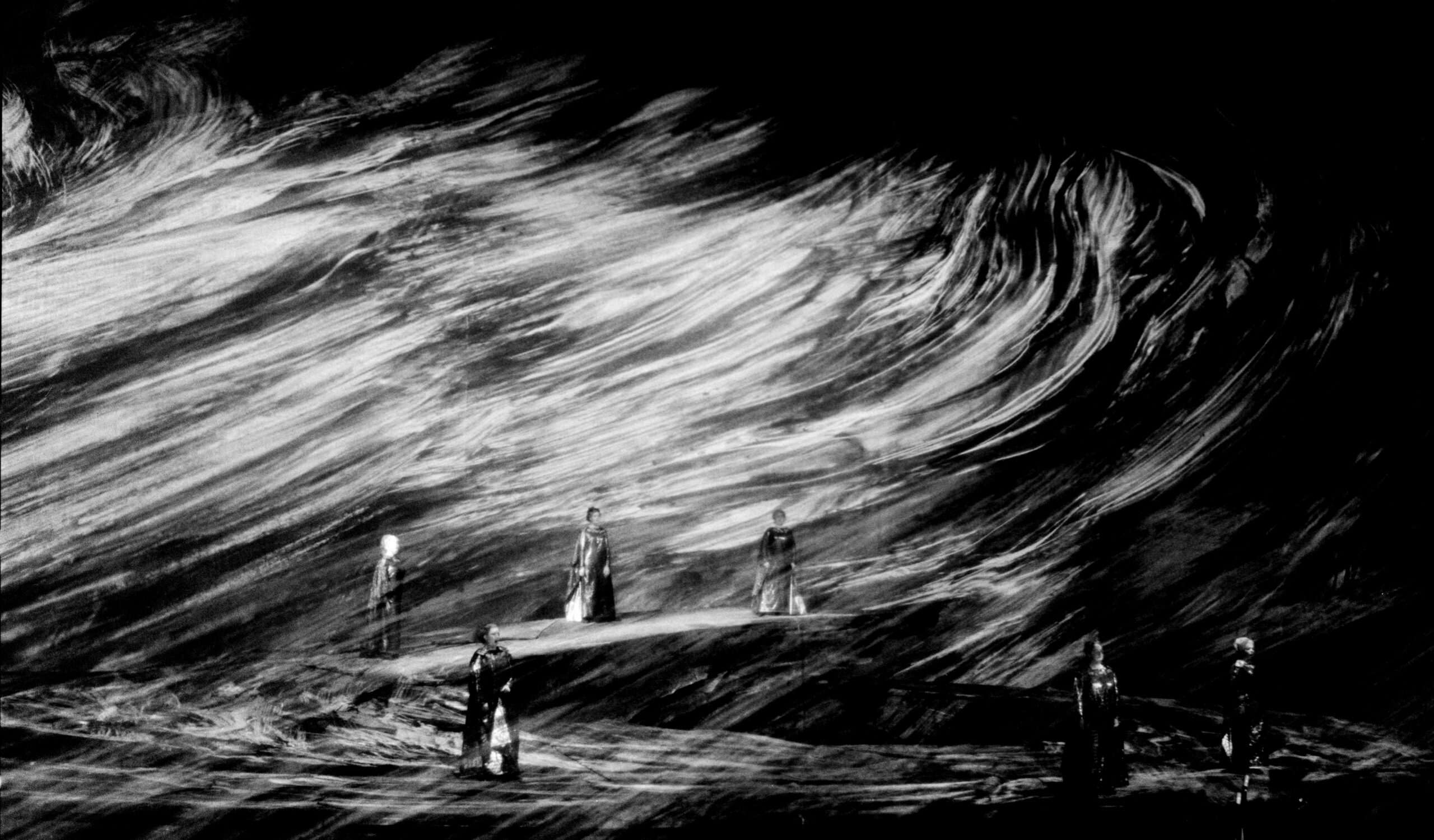
Walküre Szenenfoto, 1967 ©Siegfried Lauterwasser; Karajan-Archive
Over the following decades, the partnership continued with productions including Tristan und Isolde, the world premiere of Carl Orff’s De temporum fine comoedia, Carmen, Don Carlo and, finally, Tosca. The Easter Festival performance of Tosca on March 24, 1989, became the last opera production conducted by Herbert von Karajan.
A Father Figure and Creative Collaborator
Public perceptions of Karajan often focused on authority and perfectionism. Schneider-Siemssen, however, experienced a different side of the conductor. He remembered an artistic partner who was open to discussion, deeply engaged in visual questions and largely uninterested in the rivalries that often shaped theatre life.
Their professional relationship gradually developed into a close personal friendship. In 1969, Karajan served as Schneider-Siemssen’s best man at his wedding.
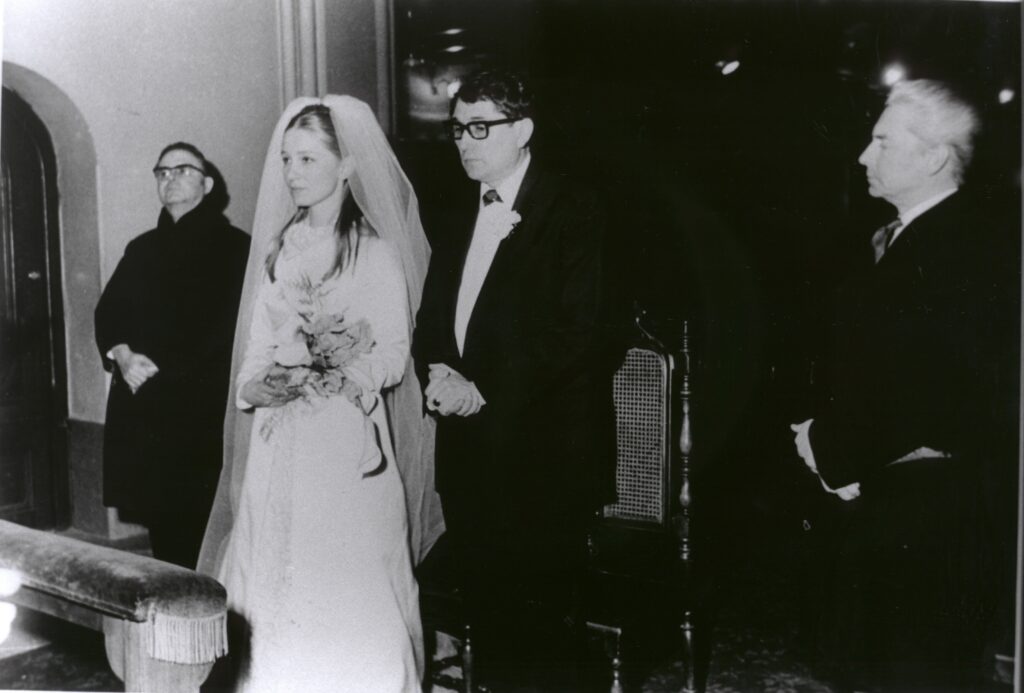
Karajan as Schneider-Siemssen’s best man at this wedding in 1969
In his autobiography, Schneider-Siemssen offered a particularly personal reflection:
I lost my father very early on, and Karajan became, so to speak, my surrogate father, my second father.
Observing Karajan’s work with musicians over many years, he also noted that the conductor stood by his orchestra “truly like a father”.
Such memories reveal a relationship that extended far beyond professional collaboration.
Legacy
Unlike conductors or singers, stage designers rarely stand in the spotlight. Yet many visual techniques that seem entirely natural in opera today — projected imagery, light as an architectural element, and the creation of atmosphere through colour rather than scenery — were already central to Schneider-Siemssen’s work decades ago.
A century after his birth, his productions continue to demonstrate how powerfully music and stage design can interact. Together, Günther Schneider-Siemssen and Herbert von Karajan created a body of work that remains among the most distinctive achievements of post-war opera production.
Selected Productions by Herbert von Karajan and Günther Schneider-Siemssen
| Year | Production |
|---|---|
| 1962 | Ludwig van Beethoven: Fidelio |
| Vienna State Opera | |
| 1962 | Wolfgang Amadeus Mozart: Die Zauberflöte |
| Vienna State Opera (Theater an der Wien) | |
| 1962 | Claude Debussy: Pelléas et Mélisande |
| Vienna State Opera | |
| 1967 | Richard Wagner: Die Walküre |
| Salzburg Easter Festival (transferred to the Metropolitan Opera, 1969) | |
| 1968 | Richard Wagner: Das Rheingold |
| Salzburg Easter Festival (transferred to the Metropolitan Opera, 1968) | |
| 1969 | Richard Wagner: Siegfried |
| Salzburg Easter Festival | |
| 1970 | Richard Wagner: Götterdämmerung |
| Salzburg Easter Festival | |
| 1972 | Richard Wagner: Tristan und Isolde |
| Salzburg Easter Festival | |
| 1973 | Carl Orff: De temporum fine comoedia |
| Salzburg Festival (World Premiere) | |
| 1974 | Richard Wagner: Die Meistersinger von Nürnberg |
| Salzburg Easter Festival | |
| 1976 | Richard Wagner: Lohengrin |
| Salzburg Easter Festival | |
| 1981 | Richard Wagner: Parsifal |
| Salzburg Easter Festival | |
| 1983 | Richard Wagner: Der fliegende Holländer |
| Salzburg Easter Festival | |
| 1985 | Georges Bizet: Carmen |
| Salzburg Festival | |
| 1986 | Giuseppe Verdi: Don Carlo |
| Salzburg Festival | |
| 1988–1989 | Giacomo Puccini: Tosca |
| Salzburg Easter Festival / Salzburg Festival |
This selection highlights some of the most important productions created by Herbert von Karajan and Günther Schneider-Siemssen between 1962 and 1989.
1 Schneider-Siemssen, Die Bühne – mein Leben, p. 19
2 ibid., p. 18
3 ibid., p. 21