09 October 2026
Pia Bernauer
Weekly SpinOn: Giving Thanks
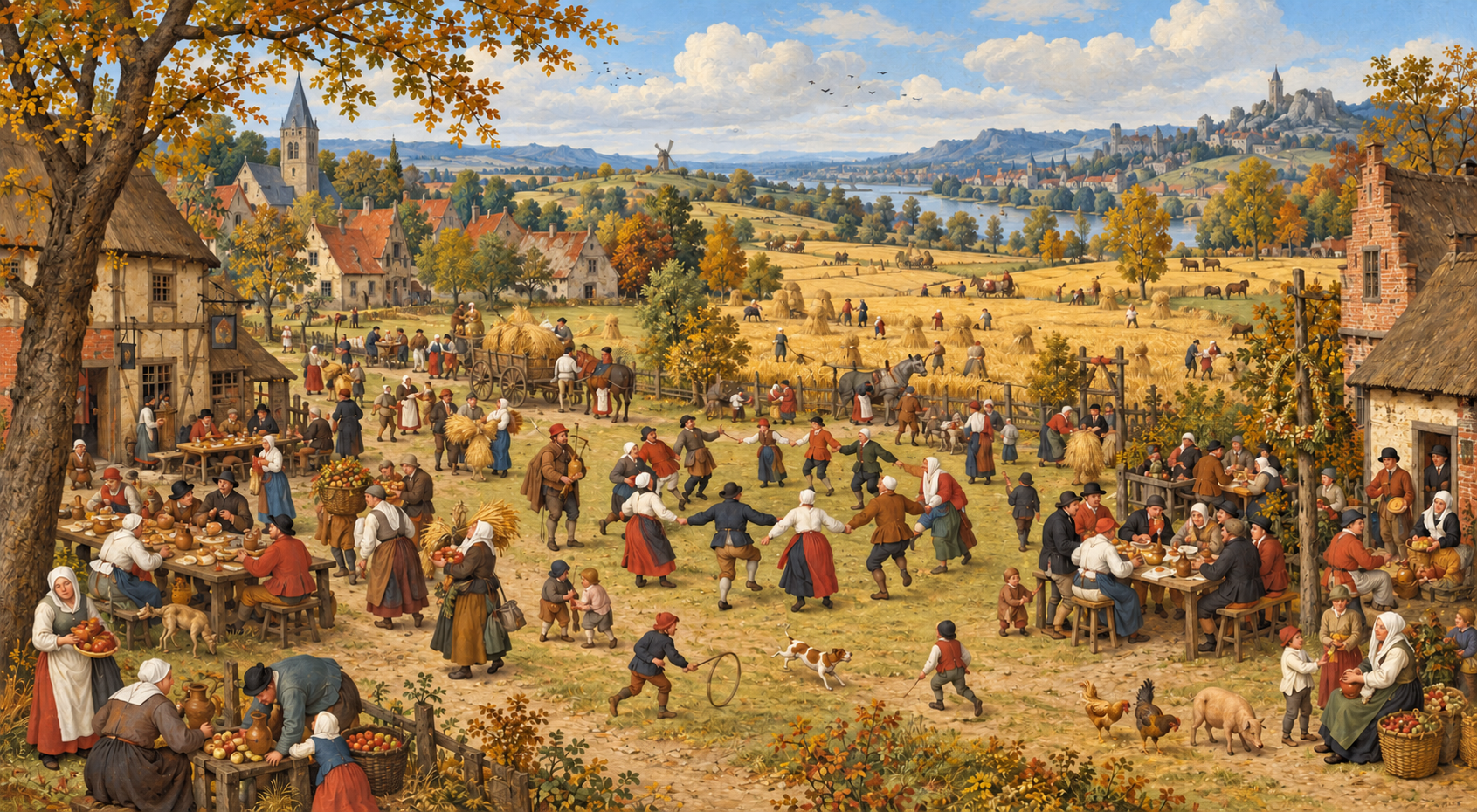
Autumn is inherently a season of gratitude, when traditional harvest festivals bring communities together to celebrate a year of demanding labor and the bounty it has finally yielded—a timeless atmosphere captured vividly in our Bruegel-inspired cover image, where villagers share food, dance, and make music amid the freshly harvested fields.
But instead of focusing only on the traditional harvest thanksgiving, this week’s playlist explores gratitude as a broader idea and how it was put into music. We move from the joy of seeing a storm pass and the sun return to a communal “Gratias” to the Almighty, and from a personal thank you to a teacher to the gratitude of regaining one’s health.
Track 1: Symphony No. 6 in F major, Op. 68 “Pastoral” – V. Shepherd’s Song: Cheerful and Thankful Feelings after the Storm. Allegretto – Ludwig van Beethoven
Berliner Philharmoniker · Herbert von Karajan
We begin our playlist with a work that has gratitude in its title: “Shepherd’s Song: Cheerful and Thankful Feelings after the Storm,” the final movement of Beethoven’s Sixth Symphony, the Pastoral.
Completed in 1808, the symphony reflects Beethoven’s love of the countryside. He often spent his summers outside Vienna and enjoyed long walks. In May 1810, two years after completing the symphony, he wrote to Therese Malfatti: “No one can love the countryside as much as I do.” In the Pastoral, he expressed the feelings he associated with country life: the pleasure of arriving, the enjoyment of a village gathering, and the fear and relief brought by a passing storm.
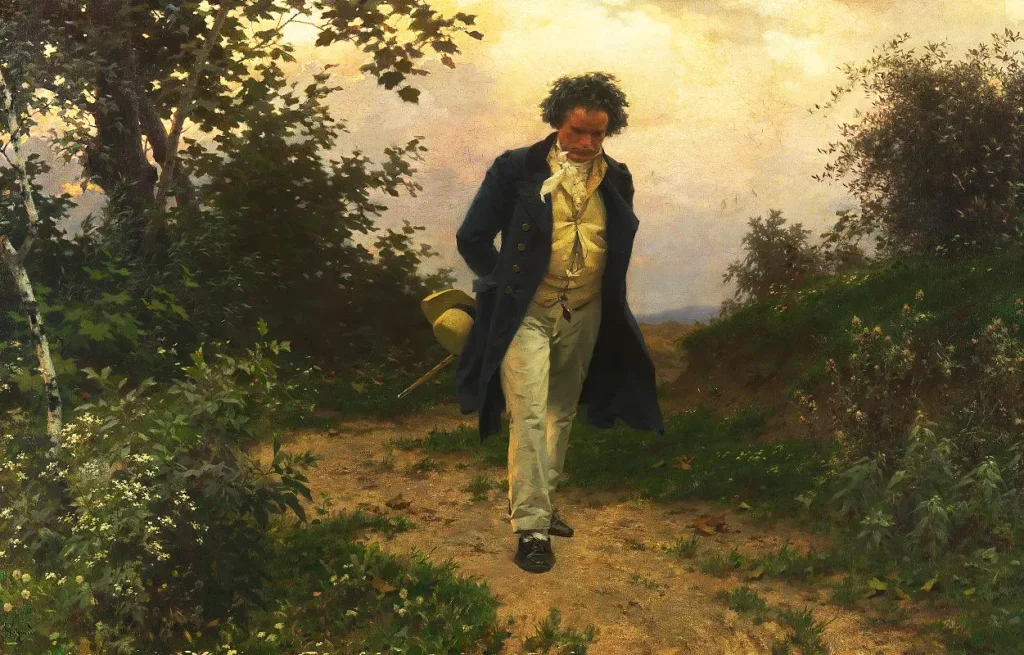
The Lonely Master: Beethoven Taking a Walk in Nature
Painting by Julius Schmid (1854–1935)
The last three movements are played without a break. A gathering of country people is interrupted by a thunderstorm, followed by the shepherd’s song of thanks. Our Bruegel-inspired cover shows a similar rural setting, with villagers sharing food, dancing and making music. For farming communities, celebrations like these depended on a successful harvest—and on the weather. Although Beethoven did not write the Pastoral for a harvest festival, its closing movement shares that sense of relief and gratitude.
Beethoven also connected this gratitude with faith. The programme for the first performance in Vienna on December 22, 1808, described the finale as an expression of thanks to God. The storm is over, and the shepherds give thanks for their safety.
Track 2: Mass in B minor, BWV 232 – Gloria: Gratias agimus tibi – Johann Sebastian Bach
Wiener Singverein · Berliner Philharmoniker · Herbert von Karajan
After Beethoven’s thanks to God following the storm, we continue with Bach’s “Gratias agimus tibi” from his Mass in B minor. The words mean “We give thanks to you for your great glory.” They are part of the Gloria, the hymn of praise that follows the Kyrie near the beginning of the Mass. Bach used the traditional Latin Mass text, as generations of composers had done before him.
The Mass in B minor developed over many years. The music of the Gratias can already be heard in Bach’s cantata Wir danken dir, Gott, wir danken dir — “We thank you, God, we thank you.” He wrote this cantata in 1731 for a church service marking the annual change of Leipzig’s town council. Its first chorus is a song of thanks to God.
In 1733, Bach adapted this chorus to the Latin words “Gratias agimus tibi.” It became part of a setting of the Kyrie and Gloria, which he presented to the new Elector of Saxony in Dresden. At this stage, the work consisted of these two sections.
Around 1748–49, near the end of his life, Bach expanded the work into the complete Mass in B minor. He added settings of the remaining Mass texts, combining new music with earlier compositions that he revised for the purpose. For the final chorus, “Dona nobis pacem” — “Grant us peace” — he returned to the music of the Gratias. The same music therefore appears twice in the finished Mass: first as thanksgiving, then as a prayer for peace.
In the Gratias, the voices enter one after another, building towards a full choral sound with trumpets. Throughout the movement, they sing the same sentence: “We give thanks to you for your great glory.”
In a radio interview from January 1950, Karajan spoke about his next major task: preparing and conducting the Vienna Bachfest. At the festival that June, he conducted Bach’s Mass in B minor with the Wiener Symphoniker, the Wiener Singverein and Kathleen Ferrier as the alto soloist. He had spent months preparing the choir and orchestra. A live recording preserves their performance, and Ferrier can also be heard in individual movements released by EMI.
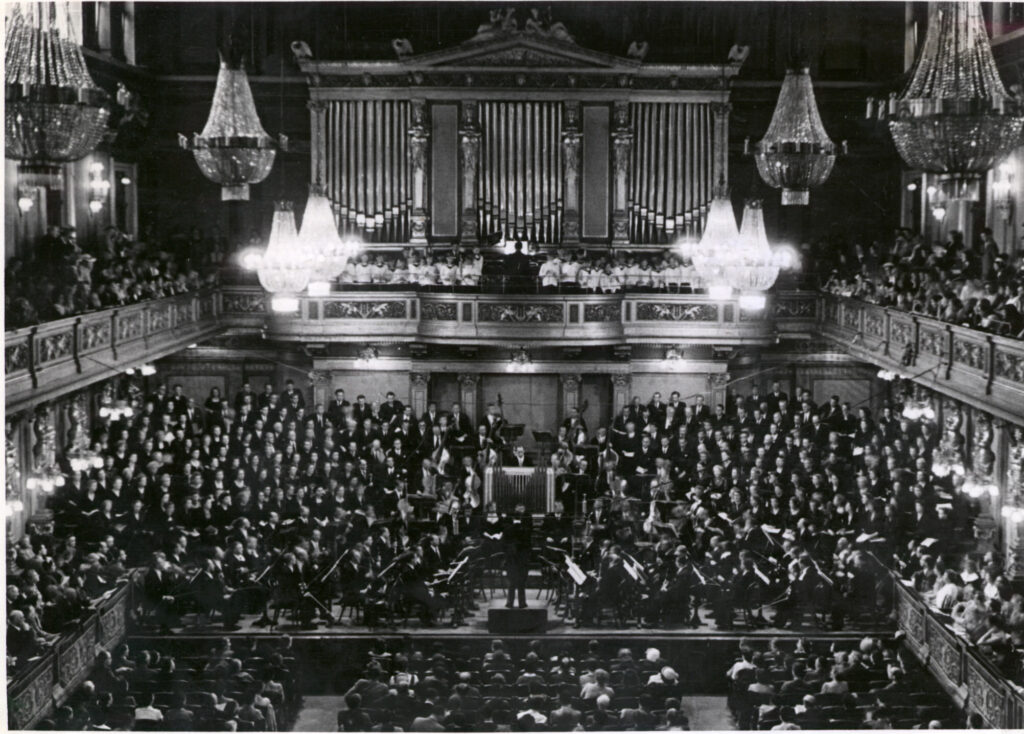
Karajan conducts J. S. Bach at the Musikverein during the international Bach festival in Vienna; VSO and Singverein. ©Nachlaß: E. Krafft; Karajan-Archive
Unfortunately, Ferrier died in 1953, just three years after their collaboration at the Vienna Bachfest. Yet in 1989, more than thirty years after her death, Karajan still spoke of her unforgettable singing of the Agnus Dei at that festival.
For this playlist, I have chosen his later recording with the Berliner Philharmoniker, made for Deutsche Grammophon at Berlin’s Jesus-Christus-Kirche between September 1973 and January 1974. The Wiener Singverein was again the choir, more than twenty years after the Vienna Bachfest. It is their voices we hear in the “Gratias agimus tibi,” giving thanks together.
Track 3: Piano Concerto No. 2 in B-flat major, Op. 83 – III. Andante – Johannes Brahms
Géza Anda · Eberhard Finke · Berliner Philharmoniker · Herbert von Karajan
With Brahms, we continue our theme of gratitude, but in this case it was a very personal thank you. When he completed his Second Piano Concerto in 1881, he dedicated it to his “dear friend and teacher Eduard Marxsen.” By then, Brahms was an established composer of 48, but he had not forgotten the man who had helped him find his way as a young musician in Hamburg. Marxsen had taught him both piano and composition, laying foundations that Brahms would continue to build on throughout his life. The dedication was a public acknowledgement of that lasting debt.
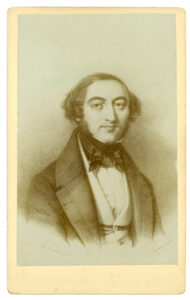
Photograph based on a lithograph by Eduard Marxsen. (Brahms Institute at the Lübeck University of Music, Inv. No. ABH 1.7.4.146)
For this playlist, we have chosen the third movement, the Andante. It begins with a surprise: the first voice we hear is a solo cello. Brahms gives it a long, singing melody, allowing an orchestral player to take the lead in a piano concerto. The piano enters later, and the movement develops through exchanges between the soloist and the orchestra.
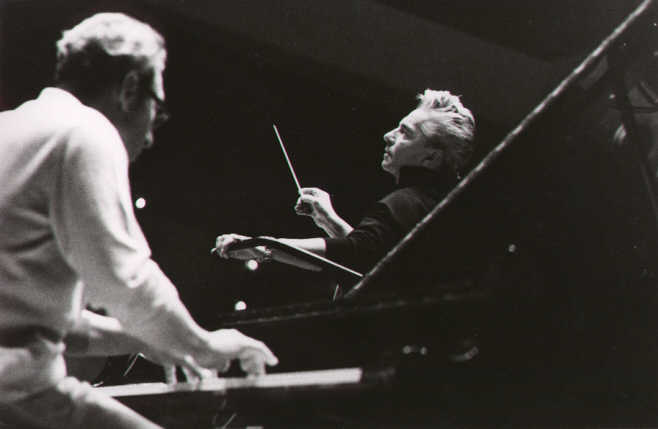
HvK (conducting) and Géza Anda (on the piano), 1968 ©Siegfried Lauterwasser;Karajan-Archive
The recording brings together musicians with a long shared history. Herbert von Karajan and Géza Anda first performed the concerto together in 1954. Over the following years, it became the work they played together most often. When they recorded it with the Berliner Philharmoniker in September 1967 at Berlin’s Jesus-Christus-Kirche, their interpretation had already developed through years of concert performances. The prominent cello solo is played by Eberhard Finke.
Brahms’s Second piano concerto held a lasting place in Karajan’s repertoire. He also recorded it with Hans Richter-Haaser and performed it with pianists including Wilhelm Backhaus, Maurizio Pollini and Alexis Weissenberg. With Anda, however, it became a particular point of connection: despite their many concerts together, this was the only work they recorded jointly in the studio.
Track 4: Symphony No. 2 in C major, Op. 61 – IV. Allegro molto vivace – Robert Schumann
Berliner Philharmoniker · Herbert von Karajan
After Brahms’s thank you to his teacher, Schumann brings us to our final reason for gratitude: feeling like yourself again after a period of illness. His Second Symphony took shape in 1845–46, during a difficult time in his life. Schumann had been struggling with poor health, and composing could demand more energy than he had. Looking back on the work, he wrote that he had begun it while still unwell. By the finale, however, he felt he was himself again.
That remark gives our final track a particularly personal background. The final movement is full of energy, but its course is not straightforward. Earlier ideas return, the momentum breaks, and a new melody gradually takes over. It recalls the closing song of Beethoven’s An die ferne Geliebte, associated with the words “Accept, then, these songs.” In Schumann’s hands, this song-like theme becomes the basis of the symphony’s jubilant conclusion.
Schumann did not describe the movement as a thanksgiving, as Beethoven had done in the Pastoral. Our connection to the theme comes from his own account of recovering his strength while working on the symphony. For a composer whose health could interrupt his ability to write, being able to work again was something substantial. The confidence of the finale belongs to that moment of recovery.
Herbert von Karajan recorded the symphony with the Berliner Philharmoniker on 16 and 17 February 1971 at Berlin’s Jesus-Christus-Kirche for Deutsche Grammophon. The sessions formed part of his complete Schumann symphony cycle.
Seven years later, Karajan also spoke in an interview about the gratitude that can follow a long illness. In this interview excerpt from 1978, he reflects on how the experience changed his view of life. His words offer a personal connection to Schumann’s account of feeling like himself again while completing the Second Symphony. For musicians whose work demands so much physical and mental energy, recovering the strength to return to it can bring a new appreciation of everyday life.
And with this most personal form of gratitude—the relief of feeling well again—we bring our musical thanksgiving to a close.
— Pia Bernauer (Karajan Institute)