09 April 2026
Pia Bernauer
Weekly SpinOn: The Romantic Piano Concerto

The piano concerto is one of the central genres of the 19th century. Around 1800, it still followed a clear model: the orchestra introduces the material, the soloist responds, and virtuosity plays a central role. Over the course of the century, this balance begins to change.
Starting with Beethoven, the relationship between piano and orchestra is rethought. The soloist becomes more closely integrated into the musical structure, and the focus shifts from display to expression. In the works of Schumann, Grieg, and Brahms, this development continues: the concerto becomes more unified, more flexible in form, and more closely connected to the composer’s individual voice.
This playlist follows that development through four works, each representing a different stage in the transformation of the piano concerto during the Romantic period
Track 1: Piano Concerto No. 4 in G major, Op. 58: II. Andante con moto – Beethoven
Walter Gieseking · Philharmonia Orchestra · Herbert von Karajan
Beethoven’s Fourth Piano Concerto in G major is widely regarded in musicology as a foundational work for the Romantic concerto, as it redefines the classical model in favour of a more inward and subjective approach. While his Fifth Piano Concerto later shaped the monumental and symphonic dimension of the genre, the Fourth provided an essential point of departure for composers such as Robert Schumann.
The first movement already signals this change. The piano opens the work alone and quietly, without an orchestral introduction. This alters the traditional balance between soloist and orchestra and places the individual voice of the piano at the centre from the outset. However, it is above all the second movement that has been understood as central to this development. Here, the contrast between both forces is reduced to its essentials: the orchestra presents short, rhythmically fixed phrases, while the piano responds with longer, more connected lines. This has often been interpreted as a dialogue — frequently associated with the Orpheus myth — in which a single voice confronts and gradually reshapes an opposing force. Whether intended programmatically or not, the movement shifts the focus from formal contrast to a more concentrated, almost psychological form of musical interaction.
This approach proved decisive for Schumann. He described Beethoven’s Fourth Concerto as one of his most important works and adopted its underlying ideas in his own Piano Concerto in A minor. As in Beethoven, the traditional opposition between soloist and orchestra is reduced, the piano enters without extended preparation, and the musical material develops as a continuous, organically connected process. The emphasis moves away from virtuosity toward what Schumann understood as a “poetic idea”.
The present recording was made in London in 1951 with the Philharmonia Orchestra and the pianist Walter Gieseking, and forms part of a series of studio sessions in which several concertos were recorded within a short period of time. This concentrated phase of recording stands within a broader, though not frequent, collaboration between Gieseking and Karajan, which can be traced from the mid-1930s to the mid-1950s and includes both these studio projects and a small number of concert appearances, such as performances in Lucerne in 1954 and at the Berlin Festival in 1955.
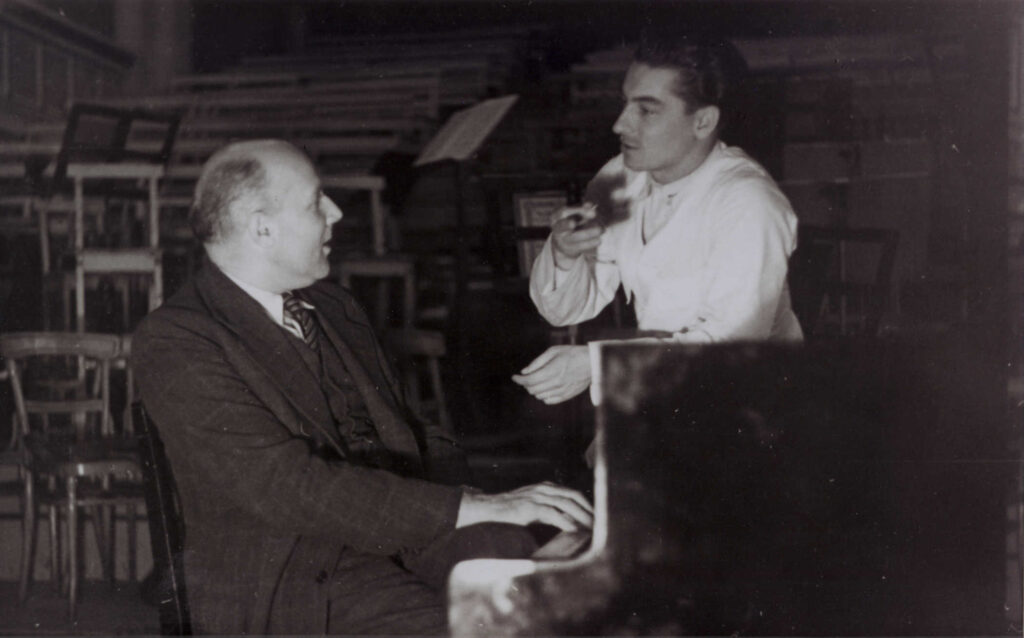
Walter Gieseking, Aachen, 1935, ©Jutta Hajmássy; Karajan-Archive
Gieseking, one of the leading pianists of his generation, was particularly associated with Mozart, Beethoven, and the French repertoire, and was known for a playing style defined by clarity of articulation and an even, unforced tone, qualities that correspond closely to the structural demands of this movement.
Track 2: Piano Concerto in A minor, Op. 54: I. Allegro affettuoso – Schumann
Maurizio Pollini · Wiener Philharmoniker · Herbert von Karajan
Building directly upon the innovations of Beethoven’s Fourth Concerto, Robert Schumann’s Piano Concerto in A minor, Op. 54, marks a decisive step in the development of what is often termed the “symphonic concerto.” Unlike the virtuoso display pieces of the early 19th century, where the orchestra merely provided a background for the pianist’s technical fireworks, the symphonic concerto treats the soloist and orchestra as equal partners. In this model, the piano is no longer set apart from the orchestra, but becomes part of the overall musical texture. It takes part in the development of the themes in the same way as the orchestral instruments. Technical skill is still present, but it is no longer the main focus. Instead, it serves the musical idea and the overall character of the work.
What characterizes this work as a quintessential Romantic concerto is its poetic unity and formal freedom. Originally conceived in 1841 as a one-movement “Phantasie,” it was only expanded into a full three-movement concerto by 1845 after Schumann struggled to find a publisher for the single movement. This “fantasy-like” origin remains visible in the work’s organic flow: the movements are closely linked, and thematic material from the first movement reappears in different forms throughout the piece, creating a continuous development rather than a sequence of clearly separated sections.
The concerto is also closely connected to Schumann’s personal life. It was written shortly after his marriage to Clara Wieck, following a long legal struggle. Clara premiered the work in Dresden in 1845 and remained its most important interpreter. The main theme of the first movement has often been linked to her name through the note sequence C–H–A–A, a typical example of the kind of musical symbolism associated with Schumann’s work, although this connection cannot be proven with certainty.
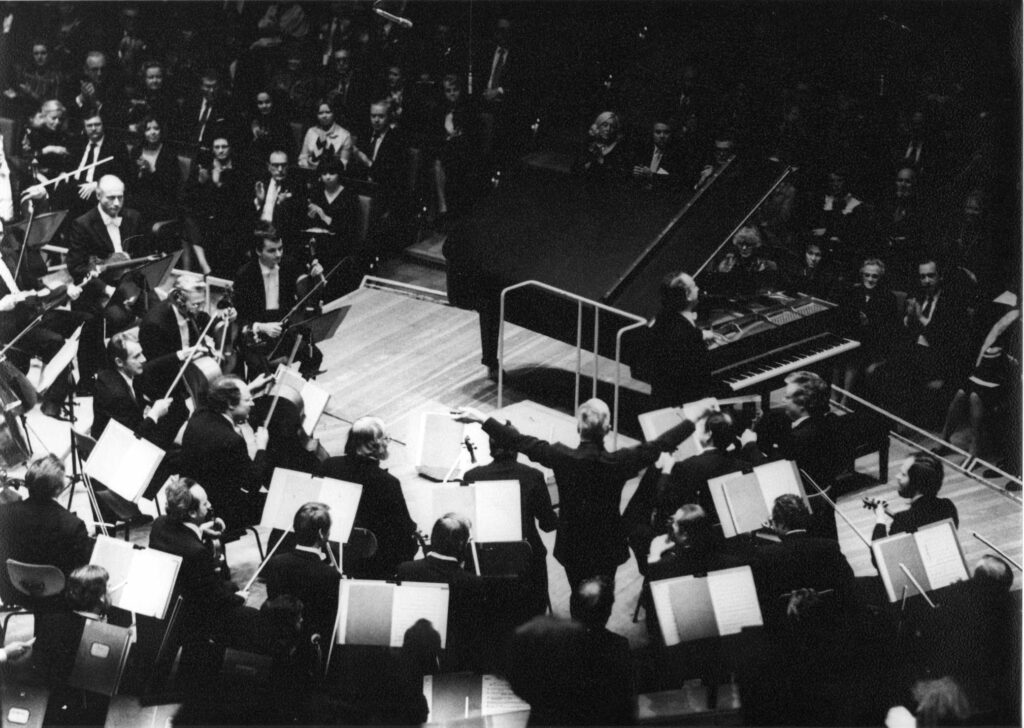
Karajan (with arms raised) Mauricio Pollini at the piano after a concert for earthquake victims in Italy in 1980
A landmark interpretation of this symphonic ideal is the recording from August 15, 1974, captured live at the Großes Festspielhaus during the Salzburg Festival. This performance brings together three titans of the classical world: pianist Maurizio Pollini, conductor Herbert von Karajan, and the Vienna Philharmonic. Originally recorded by the ORF and later released by Deutsche Grammophon (1975), this version is celebrated for its balance between Pollini’s structural clarity and Karajan’s lush, late-Romantic orchestral sound. It perfectly illustrates the “dialogue principle” discussed above, as the Vienna Philharmonic’s warm textures provide a rich foundation for Pollini’s precise, poetic phrasing, making it one of the most significant documents of Schumann interpretation in the 20th century.
Track 3: Piano Concerto in A minor, Op. 16: II. Adagio – Grieg
Krystian Zimerman · Berliner Philharmoniker · Herbert von Karajan
The lineage of the Romantic piano concerto finds its most direct successor in Edvard Grieg’s Piano Concerto in A minor, Op. 16. Written in 1868, Grieg’s work is famously modeled after Schumann’s—not only sharing the same key and a similar dramatic opening flourish but also adopting the principle of integrating national folk-like lyricism into a symphonic structure. The Adagio (the second movement) introduces a breathtaking, melancholic beauty that reflects the Norwegian landscape, characterized by muted strings and a song-like simplicity that evolves into a powerful, emotional climax. Biographically, this concerto was Grieg’s international breakthrough, written during a period of youthful optimism shortly after his marriage and blending Schumann’s structural influence with a distinct “Nordic soul.”
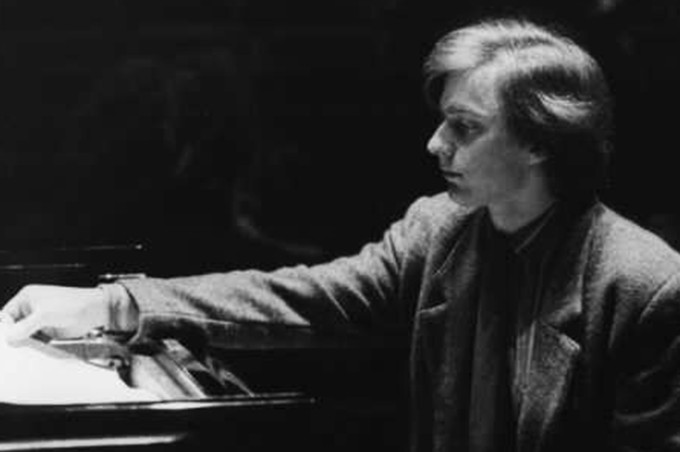
Krystian Zimerman at the Salzburg Easter Festival in 1981, ©Siegfried Lauterwasser; Karajan-Archive
A definitive realization of this late-Romantic peak is the recording featuring the young Polish pianist Krystian Zimerman and the Berlin Philharmonic, conducted by Herbert von Karajan. Produced for Deutsche Grammophon and recorded between September 27, 1981, and January 3, 1982, at the Philharmonie in Berlin, this interpretation showcases a fascinating generational bridge. While Karajan provides a vast, almost cinematic orchestral canvas with the Berlin Philharmonic, Zimerman’s touch in the Adagio remains crystalline and introspective. His sensitive use of “rubato” captures the ethereal atmosphere of Grieg’s lyricism, marking this Berlin production (published in 1982) as a cornerstone of the discography and a perfect stylistic companion to the earlier Schumann tradition.
Track 4: Piano Concerto No. 2 in B-flat major, Op. 83: IV. Allegretto grazioso – Brahms
Géza Anda · Berliner Philharmoniker · Herbert von Karajan
The development of the “symphonic concerto” reaches its most complete form in Johannes Brahms’s Piano Concerto No. 2 in B-flat major, Op. 83. Completed in 1881, 27 years after Schumann’s death, this work represents a final stage of the Romantic concerto. While Schumann and Grieg focused on unity and a more flexible, flowing form, Brahms expanded the genre into a large-scale work with four movements. In this way, the concerto comes close to a symphony with piano.
The final movement, Allegretto grazioso, differs in weight from the earlier movements. It is lighter in character and takes the form of a refined, dance-like rondo. Elements of Hungarian folk music are combined with a clear, classical structure, showing how Romantic composers integrated national styles into established forms.
Biographically, the work reflects Brahms at a mature stage of his career and his position within the tradition that leads from Beethoven through Schumann. The Allegretto grazioso has a more relaxed and intimate character, at times almost like chamber music, but within a much larger and more complex musical framework.
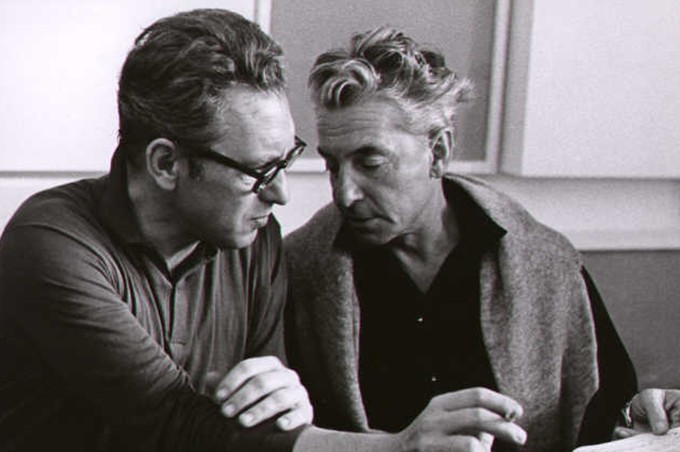
Géza Anda and Karajan in the recording studio in Berlin, 1967; ©Siegfried Lauterwasser;Karajan-Archive
A well-known recording of this work features the Hungarian pianist Géza Anda with the Berlin Philharmonic under Herbert von Karajan. It was recorded between 18 and 25 September 1967 at the Jesus-Christus-Kirche in Berlin, a venue known for its warm acoustics, and released by Deutsche Grammophon. Anda’s playing is noted for its singing tone and rhythmic precision. In the final movement, he avoids excessive emphasis and maintains a light, flexible character, in line with the marking “grazioso”. Under Karajan, the orchestra is not treated as accompaniment, but as an equal symphonic partner.
— Pia Bernauer (Karajan Institute)