03 April 2026
Pia Bernauer
Spotlight: Salzburg Easter Festival
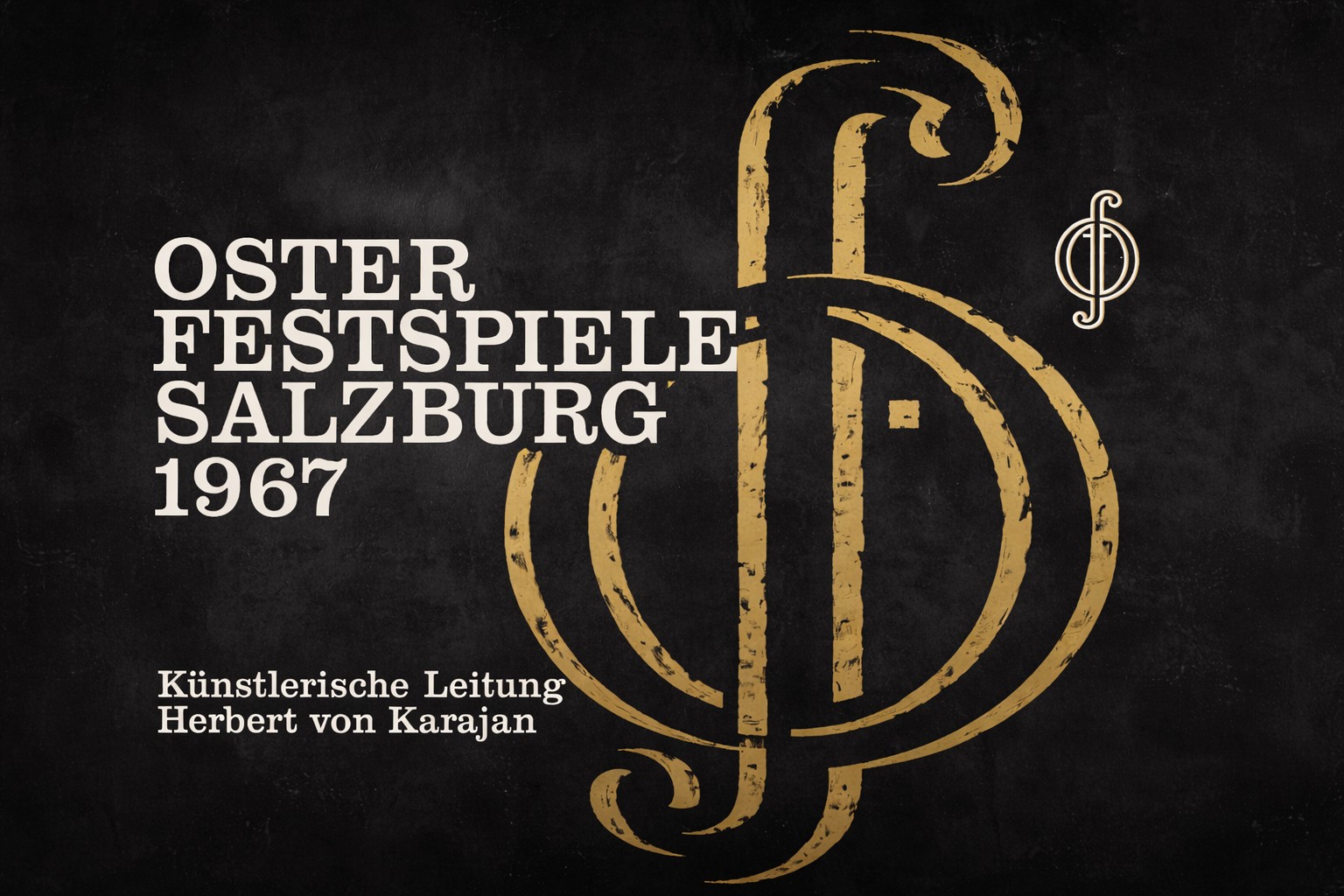
The Salzburg Easter Festival was founded in 1967 by Herbert von Karajan and takes place annually over a period of around ten days between the Saturday before Palm Sunday and Easter Monday. From the beginning, it combined staged opera productions with orchestral and choral concerts within a single, concentrated timeframe.
Karajan’s decision to establish the festival was based on practical considerations related to the production of music. In the mid-1960s, he repeatedly referred to the limitations of existing structures, particularly in opera: insufficient rehearsal time, changing personnel, and divided responsibilities between institutions and individuals. The Easter Festival was conceived as a way to organise these elements differently. At the same time, it enabled him to bring the Berlin Philharmonic into the opera pit and to establish Wagner as a central part of the programme — something that was difficult to realise during the summer months due to existing arrangements with the Bayreuth Festival.
The first Easter Festival in 1967 put this concept into practice. With Wagner’s Die Walküre at its centre, it combined staged opera with a parallel programme of orchestral and choral concerts. A defining feature from the outset was the involvement of the Berlin Philharmonic, which performed both in the opera production and in the concert programmes.
The same structure was maintained in the following years. The repertoire expanded, but the underlying organisation remained consistent: opera productions, orchestral concerts, and choral works were presented within the same period and with the same ensemble.
A key element of Karajan’s work at the Easter Festival was the relationship between studio recording and staged production. Many opera productions were prepared in advance through recordings, often made before rehearsals in Salzburg began. This allowed the musical framework — tempi, balance, and phrasing — to be established in advance. During stage rehearsals, singers could therefore focus more fully on the dramatic aspects of the production. In some cases, pre-recorded material was also used during the rehearsal process itself. At the same time, the recordings ensured that a complete version of the work was already available at the time of the premiere.
The full range of opera productions conducted by Karajan at the Salzburg Easter Festival between 1967 and 1989 is shown below:
| Year | Programme |
|---|---|
| 1967 | Richard Wagner: Die Walküre |
| 1968 | Richard Wagner: Das Rheingold |
| 1968 | Richard Wagner: Die Walküre |
| 1969 | Richard Wagner: Das Rheingold |
| 1969 | Richard Wagner: Siegfried |
| 1970 | Richard Wagner: Götterdämmerung |
| 1971 | Ludwig van Beethoven: Fidelio |
| 1972 | Richard Wagner: Tristan und Isolde |
| 1973 | Richard Wagner: Das Rheingold |
| 1973 | Richard Wagner: Tristan und Isolde |
| 1974 | Richard Wagner: Die Meistersinger von Nürnberg |
| 1975 | Richard Wagner: Die Meistersinger von Nürnberg |
| 1975 | Giacomo Puccini: La Bohème |
| 1976 | Richard Wagner: Lohengrin |
| 1977 | Giuseppe Verdi: Il trovatore |
| 1978 | Ludwig van Beethoven: Fidelio |
| 1978 | Giuseppe Verdi: Il trovatore |
| 1980 | Richard Wagner: Parsifal |
| 1981 | Richard Wagner: Parsifal |
| 1982 | Richard Wagner: Der fliegende Holländer |
| 1983 | Richard Wagner: Der fliegende Holländer |
| 1984 | Richard Wagner: Lohengrin |
| 1985 | Georges Bizet: Carmen |
| 1986 | Giuseppe Verdi: Don Carlo |
| 1987 | Wolfgang Amadeus Mozart: Don Giovanni KV 527 |
| 1988 | Giacomo Puccini: Tosca |
| 1989 | Giacomo Puccini: Tosca |
Not all productions were recorded prior to their Salzburg premieres, but a substantial number were. We prepared a playlist featuring one track from each opera, based on recordings associated with these productions and, where applicable, made in advance of the performances at the Easter Festival.
Alongside the opera productions, Karajan conducted an extensive series of concerts at the Easter Festival from 1967 to 1989. The programmes included symphonies, orchestral works, and sacred repertoire, performed within the same festival period and with the same orchestra. These concerts featured, among others, symphonies by Beethoven (including the Symphony No. 9), Brahms (Symphony No. 1 and No. 2), and Bruckner (Symphony No. 8), as well as orchestral works such as Debussy’s La Mer and Ravel’s Daphnis et Chloé. Choral repertoire formed a regular part of the programming, including Bach’s St Matthew Passion, Mozart’s Requiem, and Verdi’s Messa da Requiem, all performed within the liturgical context of Easter.
Following Karajan’s death in 1989, the festival continued under new artistic leadership, including Georg Solti, Claudio Abbado, and Simon Rattle. From 2013 to 2022, Christian Thielemann directed the festival with the Staatskapelle Dresden as orchestra in residence. Since 2023, a model with changing orchestras has been implemented. From 2026, the Berlin Philharmonic returned as resident orchestra, re-establishing the connection to the founding constellation.
— Pia Bernauer (Karajan Institute)