20 February 2026
Pia Bernauer
Weekly SpinOn: The Power of Contrast

Contrast is part of life. We experience difference constantly: tension and release, light and shadow, movement and stillness. Music works in the same way.
Differences in tempo, dynamics, register, texture and orchestration define musical form. Fast and slow, loud and soft, major and minor, solo and tutti — these oppositions articulate structure and create orientation within a work.
Herbert von Karajan described the most important moments in a work as those where the musical situation changes. A slow tempo moves into speed. A crescendo builds toward a climax. A sudden shift in dynamics changes the balance. If these points are mistimed or forced, the structure loses clarity.
This week’s playlist presents different ways composers work with contrast.
Track 1: Symphony No. 94 in G Major, Hob. I:94 “Surprise” – II. Andante – Haydn
Berliner Philharmoniker · Herbert von Karajan
Our first track presents two different forms of contrast within a single movement.
The foundation is variation. Haydn presents a simple theme and repeats it in altered forms. The melody remains recognizable, but rhythm, harmony, orchestration and dynamics change. Contrast does not arise from opposing themes, as in many symphonic movements. It results from the transformation of a single idea. The same material returns with different weight, color and intensity.
The variation principle has a long history. It appears in Renaissance and Baroque music, particularly in dance forms and keyboard works, and became a regular movement type in Classical symphonies. Haydn frequently used variation form, especially for slow movements, because it allowed structural clarity while offering room for contrast.
The second form of contrast is immediate and direct: In the Andante of Symphony No. 94, Haydn begins with a quiet, balanced theme. Immediately after its first statement, a sudden fortissimo chord interrupts the calm — the famous “surprise.” Contemporary accounts suggest that Haydn wanted to catch the attention of his London audience. Haydn was known for such musical wit. Unexpected pauses, false endings, and sudden shifts appear throughout his symphonies.
The transition to the second track introduces yet another form of contrast. Karajan often shaped his concert programs by placing works from different periods and aesthetic worlds side by side. A Classical symphony could stand beside a work of the twentieth century. The contrast was no longer confined to a single theme or movement, but structured the entire evening.
The next work reflects this broader principle.
Track 2: Pelléas und Mélisande, Op. 5 – II. Heftig – Schoenberg
Berliner Philharmoniker · Herbert von Karajan
With this track, we make a big jump from the late eighteenth into the early twentieth century.
Schoenberg’s Pelleas und Melisande was composed in 1902–03 and stands at the threshold between late Romanticism and modernism. The work is a symphonic poem, based on the symbolist drama by Maurice Maeterlinck. Unlike an opera, it is purely orchestral. The story is not sung but narrated through instrumental music. Schoenberg uses thematic transformation to depict characters and dramatic situations. Motifs associated with Pelléas, Mélisande and Golaud recur in changing forms throughout the work.

Pelleas und Melisande (Edmund Blair Leighton)
The harmonic language is highly chromatic and pushes late-Romantic tonality to its limits. Large orchestral forces and dense textures create a sound world very different from Haydn’s clarity. Sudden dynamic shifts, sharp changes of orchestral color and rapid transitions between intense climaxes and quieter passages create strong internal contrasts.
In this section marked “Heftig” (“violent/impetuous”), contrast is a core tool. Instead of a stable theme being reshaped (as in Haydn’s variations), Schoenberg creates tension through sharp oppositions of sound: sudden dynamic changes, quick shifts between thick orchestral blocks and more exposed lines, and abrupt changes in orchestral color. The music can turn from driving, aggressive motion to moments of withdrawal within a short span, and the harmony intensifies that instability.
This kind of heightened contrast is characteristic of much twentieth-century orchestral writing: bigger dynamic ranges, more extreme color, and a stronger sense of rupture rather than balance.
Karajan recorded Schoenberg’s Pelléas und Mélisande with the Berliner Philharmoniker as part of his Deutsche Grammophon project devoted to the Second Viennese School, recorded between 1972 and 1974.
Track 3: Symphony No. 6 in A Minor – II. Scherzo. Wuchtig – Mahler
Berliner Philharmoniker · Herbert von Karajan
With the third track, we remain in the early twentieth century. Mahler composed his Sixth Symphony in 1903–04, almost simultaneously with Schoenberg’s Pelléas und Mélisande. Both works expand late-Romantic language, yet they organize contrast in different ways.

Gustav Mahler, 1909
Mahler’s Scherzi occupy a distinctive place in his symphonies. Traditionally, a scherzo is a lively movement in triple meter, often derived from dance. Mahler retains this framework but reshapes it. Ländler-like rhythms appear in altered form. Accents displace the regular pulse. What resembles a dance can quickly turn heavy, rigid or unstable.
The movement unfolds in clearly profiled sections. Strongly differentiated characters follow one another rather than being smoothly developed. This juxtaposition of sharply contrasted blocks creates a collage-like effect within the traditional scherzo form. The Scherzo was chosen here because it contains pronounced internal contrasts of rhythm, texture and character.
In Mahler, however, contrast also shapes the larger structure of the symphony. The order of the middle movements has long been debated. Mahler first placed the Scherzo second and later reversed the order with the Andante. In this recording, Karajan follows the Scherzo–Andante sequence. After the dark first movement, the symphony does not turn immediately toward a lyrical space. The Scherzo continues and intensifies the tension. Only afterwards does the Andante introduce a contrasting character.
Track 4: Symphony No. 6 in A Minor – III. Andante moderato – Mahler
Berliner Philharmoniker · Herbert von Karajan
The Andante moderato stands in clear contrast to the Scherzo.
The Scherzo is marked Wuchtig (forceful) and written in 3/8 meter. Its rhythm is tense and unsettled, with strong accents and heavy orchestral sound.
The Andante moderato moves in 4/4 meter and has a steadier pulse. Longer cantabile lines replace the sharp rhythmic gestures of the Scherzo. The sound becomes more transparent, and the dynamics develop more gradually through crescendos and decrescendos. The contrast between the two movements is clear: tension versus breadth, weight versus openness.
In this recording, Karajan follows the Scherzo–Andante order. After the dark first movement, the symphony first increases its tension in the Scherzo. Only then does the Andante introduce a calmer and more lyrical character.
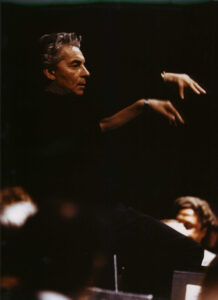
@Siegfried Lauterwasser, Karajan Archive
But the Andante is not the end. A final movement follows. This large-scale finale gathers the tensions of the earlier movements and brings them to a dramatic conclusion. Unlike several other Mahler symphonies, the Sixth does not end in affirmation or triumph. Its course remains tragic.
Karajan spoke of a “great tragic sense” in Mahler. In the Sixth Symphony, this tragic character shapes the entire structure of the work.
— Pia Bernauer (Karajan Institute, Salzburg)