Early in 1977, Anne-Sophie Mutter played for Herbert von Karajan in a private audition. Much has been said and written about this encounter and the collaboration that followed. But this Weekly SpinOn centres on a principle that guided Karajan’s work with Anne-Sophie Mutter from the very beginning: repertoire choice was decisive, shaped by timing and long-term artistic growth. Follow the repertoire path Karajan developed with her, from the first to the final recording.
Track 1: Violin Concerto No. 3 in G major, K. 216 – I. Allegro – Mozart
Berliner Philharmoniker · Herbert von Karajan · Anne-Sophie Mutter
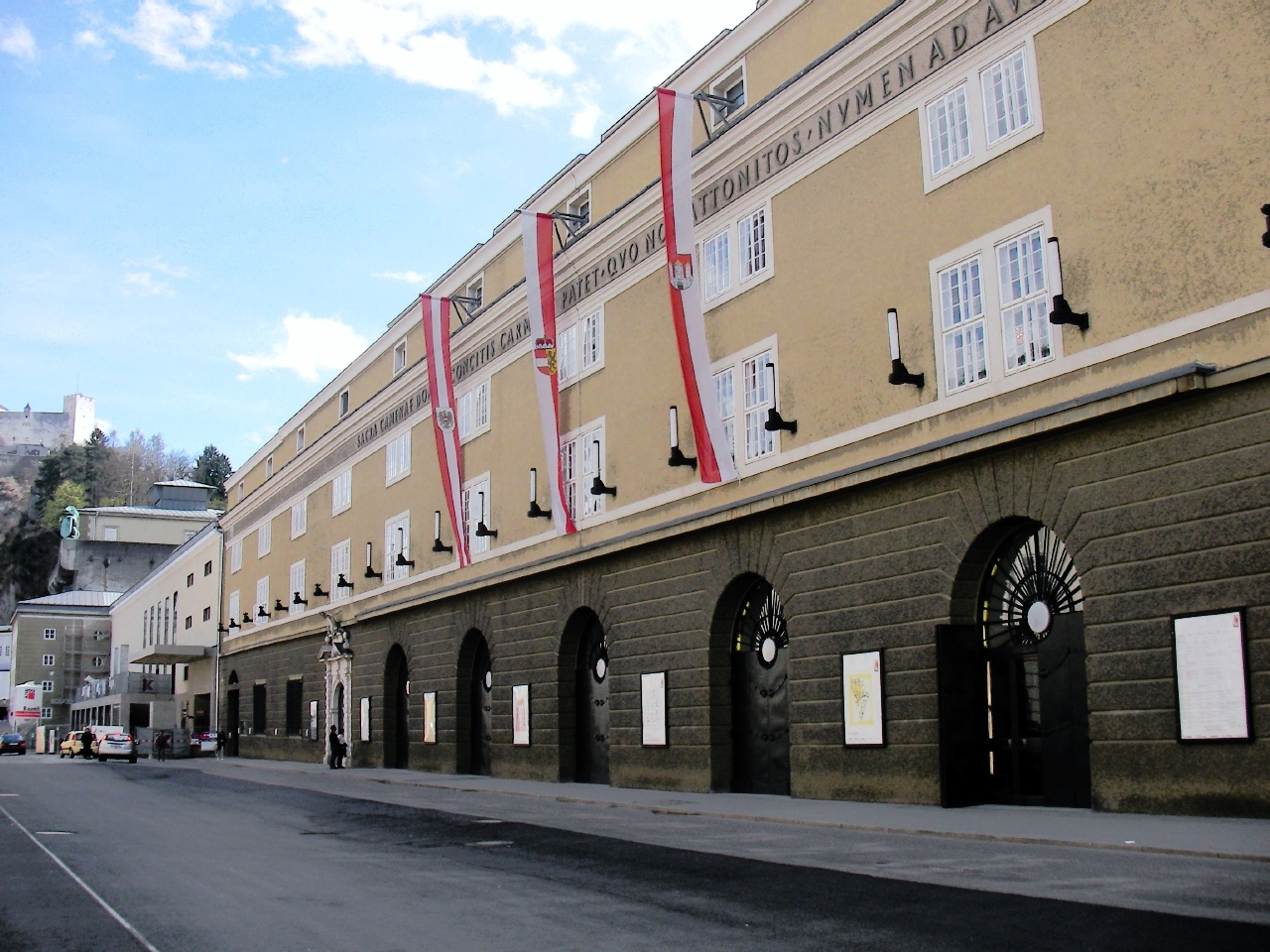
Only a few months after their first meeting, Mutter and Karajan appeared together in concert for the first time on 29 May 1977, performing Mozart’s Violin Concerto No. 3 in G major at the Salzburg Whitsun Festival. Over the months that followed, the concerto remained part of their concert programmes and was performed several times before any recording took place.
It was no coincidence that Karajan started there collaboration with Mozart’s Third Violin Concerto. At around twenty minutes, its duration corresponds to what was typical for concertos of the period and stands in clear contrast to the broader symphonic scope of later violin concertos. Written in 1775, when Mozart was 19 and employed at the Salzburg court, the work belongs to a type of violin concerto that was common at the time: concise in length and clearly structured.
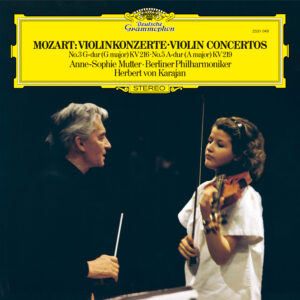
When the time finally came to record this repertoire in February 1978, after months of performing the piece in concert, the Third Violin Concerto was paired with Mozart’s Fifth. Having established the more conventional work in concert, the 5th concerto, with its more distinctive character, provided a natural contrast and made for a full programme for Mutter’s first LP with Karajan.
Track 2: Violin Concerto in D major, Op. 61 – III. Rondo. Allegro – Beethoven
Berliner Philharmoniker · Herbert von Karajan · Anne-Sophie Mutter
Beethoven’s Violin Concerto followed soon after the first Mozart recordings and marked a clear next step in Anne-Sophie Mutter’s repertoire with Herbert von Karajan. The work entered their concert programmes in 1979 and was performed several times before it was recorded later that same year.
Composed in 1806, Beethoven’s Violin Concerto represents a decisive expansion of the genre. At over forty minutes, it is more than twice the length of Mozart’s Third Violin Concerto and unfolds on a broader scale. The orchestra takes on a symphonic role, and the solo part is integrated into a long, continuous musical argument rather than a sequence of clearly separated gestures.
Karajan did not introduce the concerto directly as a recording project. Instead, it was first tested in concert, allowing the demands of the work to be addressed in performance before being fixed on record. Compared to Mozart, the transition to Beethoven was swift, but it was clearly planned, extending the collaboration into repertoire of greater length, weight, and structural complexity.
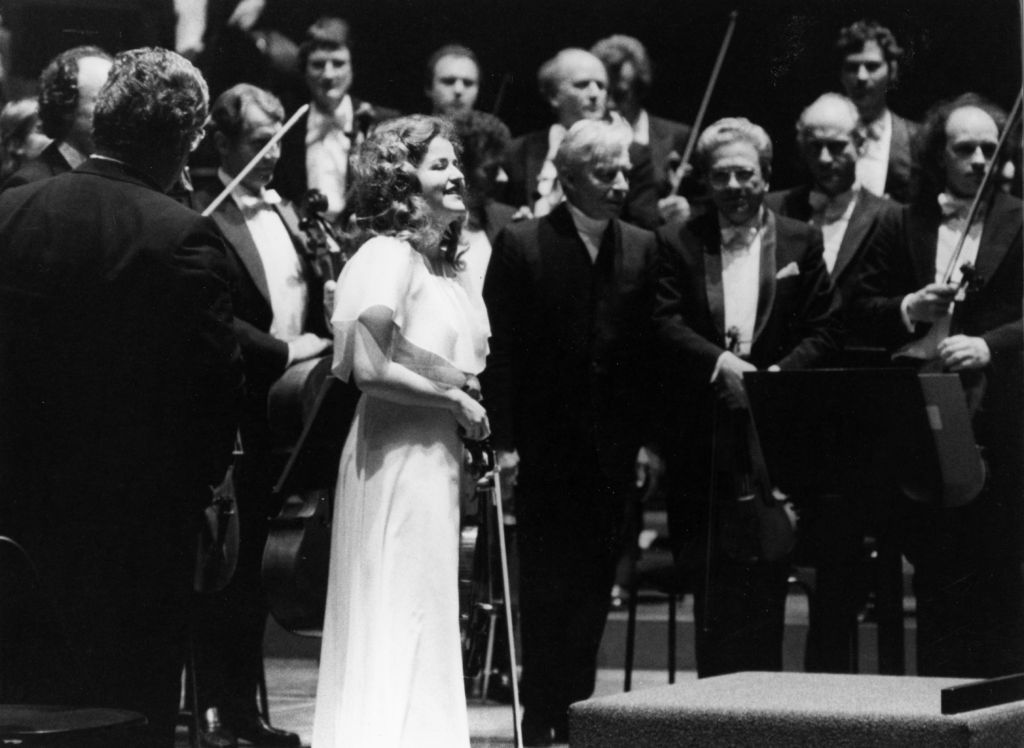
For Anne-Sophie Mutter, Beethoven’s Violin Concerto has remained closely associated with Herbert von Karajan. In later reflections, she has often linked the work to their shared performances and to the particular sound world shaped during this phase of their collaboration.
Track 3: Violin Concerto in D major, Op. 77 – III. Allegro giocoso, ma non troppo vivace – Brahms
Berliner Philharmoniker · Herbert von Karajan · Anne-Sophie Mutter
Johannes Brahms’s Violin Concerto occupies a special position in the repertoire, not least because of its final movement. The third movement departs from the model of the virtuosic finale as light entertainment and instead unfolds with pronounced rhythmic energy and an earthy character. Drawing on Hungarian and folk-like elements, the movement retains a strong orchestral presence and forms an integral part of the concerto’s overall structure rather than serving as a purely decorative conclusion.
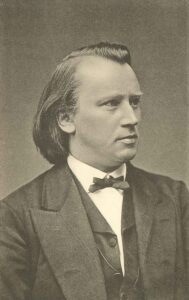
Completed in 1878, the concerto belongs to the core repertoire of the late nineteenth century. In scale it stands alongside Beethoven’s Violin Concerto, but its musical language is more densely organised, with substantial orchestral writing throughout. The orchestra plays an active role in shaping the musical framework, within which the solo part must project and maintain momentum, particularly in the finale.
In the collaboration between Anne-Sophie Mutter and Herbert von Karajan, Brahms’s Violin Concerto marked a further step after Mozart and Beethoven. As with the earlier repertoire, the work was first introduced in concert before being recorded. The concerto places sustained demands on both soloist and orchestra across all three movements, culminating in a finale whose drive and rhythmic intensity leave little room for repose.
In Mutter’s early recordings with Karajan, Brahms’s Violin Concerto holds an important place. It extends the collaboration into repertoire of greater density and orchestral involvement, continuing the progression from Classical and early Romantic concertos toward the concentrated symphonic language of the late nineteenth century.
Track 4: Violin Concerto in D major, op. 35 – II. Canzonetta. Andante – Pyotr Ilyich Tchaikovsky
Wiener Philharmoniker · Herbert von Karajan · Anne-Sophie Mutter
After the Brahms recording, the two did not continue with another large-scale Romantic violin concerto. Instead, their work together shifted toward different repertoire. They recorded works by Bach and Vivaldi, turning toward music that demands precision, clarity, and stylistic discipline rather than symphonic breadth. Technically, this repertoire represents no reduction in difficulty. On the contrary, Bach and Vivaldi place strict demands on intonation, articulation, and control, exposing every detail of sound and leaving little room for concealment.
Karajan consistently stressed that repertoire should be shaped in performance before being fixed on record, particularly with younger artists. Recordings, in his view, were not starting points but documents of a stage already reached. In his later years, this approach increasingly favoured live recordings, which he regarded less as definitive statements than as snapshots of a musical moment.
After years spent in Baroque repertoire, the technical and stylistic discipline required by Bach and Vivaldi provided a contrasting foundation for the return to the Romantic repertoire. Tchaikovsky’s Violin Concerto appears at a very late point in the recorded collaboration between Anne-Sophie Mutter and Herbert von Karajan. Recorded live in 1988, Tchaikovsky’s Violin Concerto is the final documented recording made by Herbert von Karajan and Anne-Sophie Mutter. Within the work, the second movement, the Canzonetta, occupies a special place. It opens with a woodwind introduction led by the oboe, establishing a restrained, darkened colour. When the violin enters, it continues this sound world rather than contrasting with it, unfolding in a similarly veiled and inward manner. In this performance, the focus lies on sustained tone, phrasing, and colour, shaped in the immediacy of a live situation.

As their last recorded collaboration, this performance stands apart from the earlier studio recordings. It captures a mature partnership in a live setting, defined less by symphonic weight or virtuoso display than by restraint, nuance, and close attention to sound itself.
— Pia Bernauer (Karajan Institute, Salzburg)